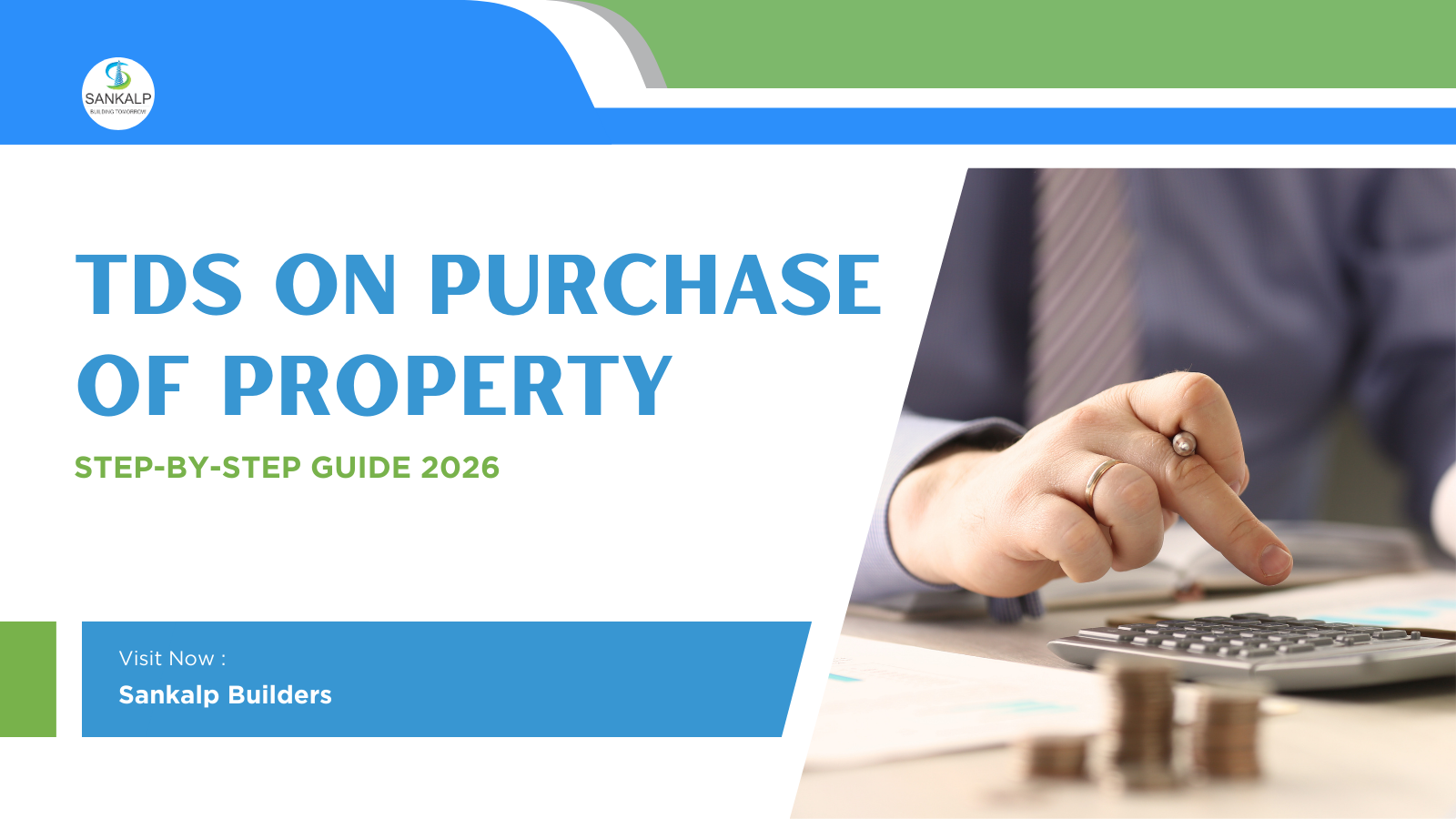
TDS on Purchase of Property: Rates, Rules and Complete Guide
TDS on purchase of property is one of the most commonly missed responsibilities in an Indian real estate deal, and the surprise is that it falls on the buyer, not the seller. If you buy a house, flat, plot or commercial unit worth Rs 50 lakh or more, the law requires you to deduct a small percentage of the payment and deposit it with the government before the rest goes to the seller. Miss this step, and you can face interest, penalties and a stalled registration. This guide explains the rules, rates, forms and process in plain language, so you stay compliant and stress-free.
The figures here reflect the position for 2026. Tax rules change, and the law is being modernised under the new Income-tax Act, so treat this as an informational guide and confirm the current position on the income tax portal or with a chartered accountant before you file.
What Is TDS?
TDS stands for Tax Deducted at Source. It is a system where the person making a payment deducts a small part as tax and deposits it directly with the government, instead of the receiver paying it later. In a property deal, the buyer deducts the tax from the amount payable to the seller and pays it to the government on the seller's behalf. The seller then gets credit for that amount against their own tax.
Why Is TDS on Property Important?
The government introduced TDS for property buying to track high-value transactions and reduce the use of unaccounted money in real estate. It creates a clear paper trail for every large deal. For you as a buyer, it matters because the duty is legally yours. If you skip it, the tax office can treat you as an assessee in default, and the cost lands on you, not the seller.
What Is Section 194-IA?
Section 194-IA of the Income Tax Act is the rule that governs TDS on purchase of immovable property from a resident seller. It says that any buyer of immovable property, other than rural agricultural land, must deduct 1% TDS when the sale consideration or the stamp duty value is Rs 50 lakh or more.
A helpful feature of this section is that you do not need a TAN (Tax Deduction Account Number) to comply. You can use your PAN and the seller's PAN, which keeps the process simple for ordinary buyers.
Properties Covered Under Section 194-IA
- Covered: residential flats and houses, commercial units, and land (except rural agricultural land), valued at Rs 50 lakh or more.
- Not covered: rural agricultural land, and any property where both the sale value and stamp duty value are below Rs 50 lakh.
One point trips up many buyers: the 1% applies to the full purchase price, not just the amount above Rs 50 lakh. So a flat bought for Rs 75 lakh attracts TDS of Rs 75,000, not 1% of the Rs 25 lakh excess.
TDS Rates on Purchase of Property
The rate depends entirely on the seller's residential status, and this is the single most important thing to confirm before you deduct anything.
- Resident seller (Section 194-IA): 1% (property Rs 50 lakh or more)
- NRI seller (Section 195): based on capital gains, plus surcharge and cess (no Rs 50 lakh threshold)
For a resident seller, the 1% rate is straightforward. If the seller does not provide a PAN, the rate rises sharply to 20%, so always collect the seller's PAN first.
TDS on Property Purchase from an NRI (Section 195)
Buying from an NRI is a completely different exercise, and mixing it up with the 1% rule is a common, costly error. When the seller is a non-resident, Section 195 applies, not Section 194-IA. The key differences:
- There is no Rs 50 lakh threshold. TDS applies whatever the property value.
- The rate is based on the seller's capital gains, not a flat 1%. For long-term gains it is generally 12.5% plus surcharge and cess; short-term gains are taxed at the seller's slab.
- Surcharge is added in slabs on higher-value deals, and a 4% health and education cess applies on top.
Under Budget 2026, buying from an NRI seller has been made a little easier: a PAN-based facility on the income tax portal now allows this compliance without a separate TAN in the specified cases. Because NRI deductions can run into lakhs, the seller can apply for a Lower Deduction Certificate to reduce the amount, and it is wise to involve a chartered accountant for these deals.
How to Calculate TDS on Purchase of Property
For a resident seller, the calculation is simple. Take the higher of the sale consideration or the stamp duty value, and apply 1%.
Example: You buy a flat for Rs 80 lakh, and the stamp duty (DLC) value is Rs 78 lakh. TDS is 1% of the higher figure, Rs 80 lakh, which is Rs 80,000. You pay the seller Rs 79,20,000 and deposit Rs 80,000 with the government.
If you pay in instalments, you deduct 1% from each instalment as you pay it. With joint buyers or sellers, the Rs 50 lakh threshold is judged on the total property value, and each buyer-seller pair may need a separate filing.
When and How to Deduct TDS on Property Purchase
Follow these steps in order:
- Confirm the seller's residential status (resident or NRI) and collect their PAN.
- Deduct TDS at the time of payment or credit, whichever is earlier.
- Deposit the TDS using Form 26QB within 30 days from the end of the month of deduction.
- Download Form 16B from the TRACES portal and issue it to the seller as proof.
What Is Form 26QB and Form 16B?
Form 26QB is the combined challan-cum-statement you use to deposit the TDS. It captures the buyer and seller PAN, property details and the amount. Form 16B is the TDS certificate you download afterwards and hand to the seller, so they can claim credit for the tax you deducted.
A note on the difference between Form 16A and Form 16B: Form 16A is a general TDS certificate for non-salary payments like interest or rent, while Form 16B is specific to TDS on property transactions under Section 194-IA.
When Is TDS Deduction Not Necessary?
- When both the sale value and stamp duty value are below Rs 50 lakh (for a resident seller).
- When the property is rural agricultural land.
For NRI sellers there is no such threshold, so the "below Rs 50 lakh" exemption does not apply to them.
How to Claim a TDS Refund
TDS is not the buyer's money to reclaim, it belongs to the seller, who claims credit for it. The seller sees the deducted amount reflected against their PAN and adjusts it in their income tax return. If the seller's actual tax liability is lower than the TDS deducted, the excess is refunded to the seller when they file their return, subject to the department's processing. This is common in NRI deals, where the higher TDS often exceeds the real tax due, and a Lower Deduction Certificate helps avoid locking up large sums.
Latest Developments: The New Income-tax Act
The framework is being modernised. For transactions where the payment or credit happens on or after 1 April 2026, the new Income-tax Act, 2025 applies. In substance the rule is unchanged for resident sellers, 1% TDS, buyer responsible, but the section numbers and forms are being renumbered. Section 194-IA maps to the new Section 393, and Form 26QB is being replaced by Form 141. Because the rollout is recent, confirm the current form and procedure on the income tax portal at the time of your transaction.
What This Means for Buyers in Jaipur
With property prices in growing cities regularly crossing Rs 50 lakh, this compliance now touches almost every serious deal. If you are buying apartments in Jaipur or comparing flats in Jaipur, budget for the TDS step alongside your other costs like stamp duty in Rajasthan and registration charges. Checking the stamp duty (DLC) value for your locality matters here too, since TDS is charged on the higher of your price or that value.
Buying from established developers makes the paperwork smoother. Many of the top builders in Jaipur provide clean documentation and clear seller details, which helps you file Form 26QB correctly. Verifying a project on the RERA site adds another layer of confidence before you deduct and deposit the tax.
FAQs
- Do I need to pay 1% TDS on a property purchase?
Yes, if you buy immovable property (other than rural agricultural land) worth Rs 50 lakh or more from a resident seller. You deduct 1% of the higher of the sale price or stamp duty value and deposit it using Form 26QB. - What happens if the buyer does not deduct TDS on property?
The buyer can be treated as an assessee in default and face interest, a late-filing fee and penalties. The registration process can also be affected, so it is best to deduct and deposit on time. - How is TDS different when buying from an NRI?
For an NRI seller, Section 195 applies instead of the 1% rule. There is no Rs 50 lakh threshold, and TDS is based on the seller's capital gains plus surcharge and cess, usually a much higher amount. A chartered accountant is strongly advised. - Is TDS on property refundable?
The TDS belongs to the seller, not the buyer. If the tax deducted is more than the seller's actual liability, the excess is refunded to the seller when they file their income tax return, subject to processing.
Sources and References
- Income Tax Department, Government of India (incometaxindia.gov.in), Section 194-IA guidance and TDS tutorials on purchase of immovable property.
- Income-tax Act, 2025 provisions renumbering Section 194-IA to Section 393 and Form 26QB to Form 141, for transactions from 1 April 2026.
- TRACES portal (tdscpc.gov.in) for Form 16B, and the income tax portal for Form 26QB filing.
- Budget 2026 update on the PAN-based facility for TDS in NRI-seller transactions.
Last updated 2026. TDS rates, forms and procedures can change, and the new Income-tax Act is being rolled out. This article is for information only and is not tax advice. Confirm the current rules on the income tax portal or with a chartered accountant before deducting or filing.

Anil Shah
The Anil Shah editorial team writes about Jaipur real estate - market trends, home-buying guides, RERA updates and investment insights - drawing on 25+ years of building landmark residential and commercial projects across the city.
Looking for your dream property in Jaipur?
Explore RERA-certified homes & commercial spaces by Sankalp Group. Book a free site visit today.