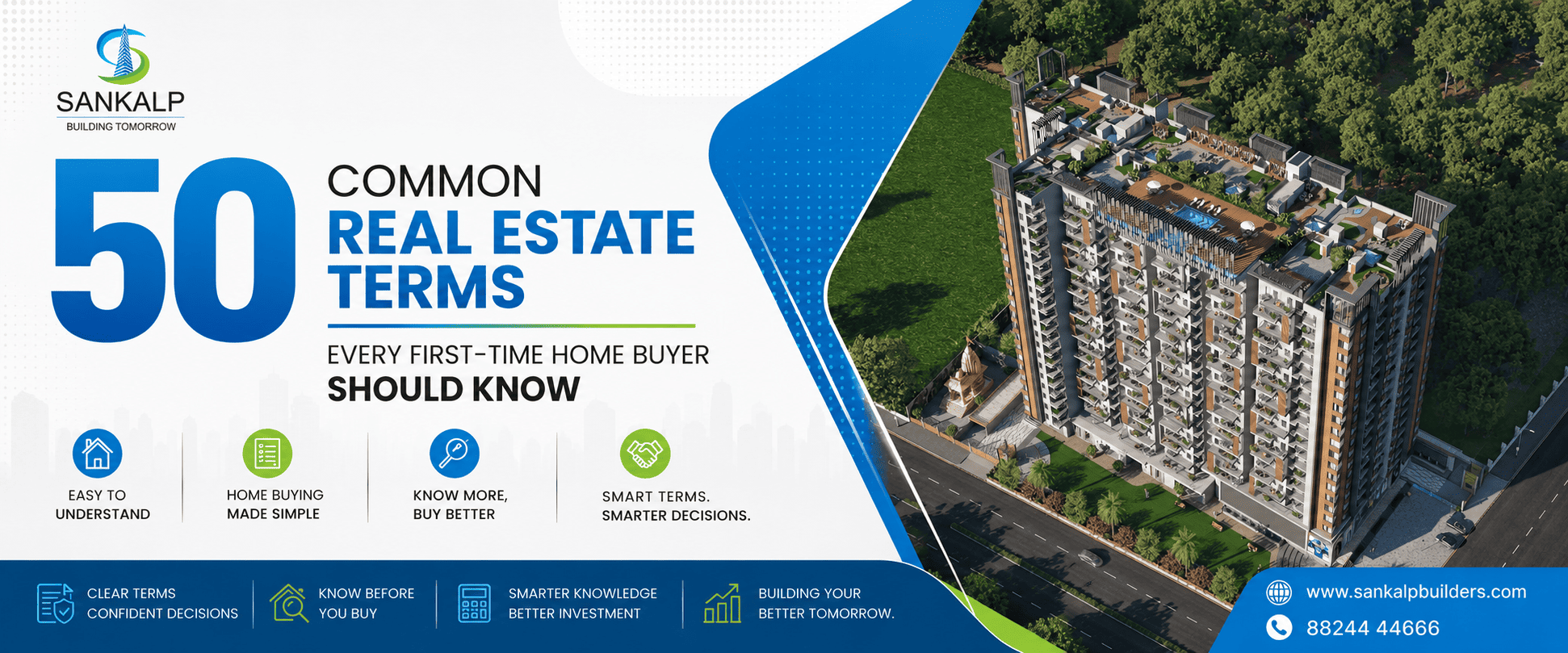
Walk into your first property meeting and the jargon hits fast: carpet area, RERA, encumbrance, EMI. Not knowing the Real Estate Terms puts you at a disadvantage, because the person across the table uses them fluently. This glossary breaks down 50 common terms in plain language, grouped by where they come up, so you can follow any conversation about buying a home with confidence.
Area and measurement terms
These decide how much space you actually get, so learn them first.
- Carpet area: the real usable space inside your walls
- Built-up area: carpet area plus the walls and balcony
- Super built-up area: built-up area plus your share of common spaces
- RERA carpet area: the legal definition of carpet area under RERA
- Loading factor: the gap between carpet and super built-up area
- Plot area: the size of the land itself
- FSI or FAR: the ratio of built-up area allowed on a plot
- Saleable area: the area a builder charges you for, usually super built-up
Legal and approval terms
This real estate terminology protects your money and your title.
- Title deed: proof the seller legally owns the property
- Encumbrance certificate: proof no loan or claim sits on the property
- RERA: the Real Estate Regulation Act, which registers and regulates projects
- Occupancy certificate: proof a building is fit to live in
- Completion certificate: proof construction met the approved plan
- Patta: a land title record showing legal tenure
- Mutation: updating municipal records to your name after purchase
- Power of Attorney: authority for someone to act on your behalf
- Sale deed: the document that legally transfers ownership
- Agreement for sale: the contract before the final sale deed
- Mother deed: the document tracing past ownership
Money and loan terms
Some of the most important real estate terms to know involve your finances.
- EMI: the equated monthly instalment on your home loan
- Down payment: the portion you pay upfront, usually 20 to 25 percent
- LTV: loan-to-value, the share of the price a bank funds
- Principal: the loan amount before interest
- Tenure: the length of your loan
- Pre-EMI: interest paid during construction before full EMI starts
- Processing fee: the bank's charge to set up the loan
- Foreclosure: repaying the loan in full before its tenure ends
- Repo rate: the RBI rate that influences your loan interest
Cost and tax terms
These add to the price, so budget for the terminology used in real estate around charges.
- Stamp duty: a state tax on registering the property
- Registration fee: the charge to record the sale, usually 1 percent
- DLC rate: the government's minimum value for an area, also called circle rate
- GST: tax on under-construction property, nil on a ready flat with occupancy certificate
- TDS: tax deducted at source, 1 percent on deals of Rs 50 lakh or more
- Maintenance charge: the monthly fee for upkeep of common areas
- Capital gains: the profit when you sell, taxed by holding period
Property type and status terms
Knowing these terms used in real estate helps you compare options.
- Under construction: a project not yet completed
- Ready to move: a finished, occupiable home
- Resale: a property sold by an existing owner, not the builder
- Freehold: full ownership of the property and land
- Leasehold: ownership for a fixed lease period
- Possession: the date you receive the keys
- Carpet-ready: finished to a habitable standard
- Bare shell: handed over without internal finishes
Buyer and project terms
The rest of the realestate definitions cover common project language.
- Promoter: the developer of a project
- Allotment letter: confirmation of the specific unit assigned to you
- BHK: bedroom, hall and kitchen, as in 2 BHK
- Amenities: shared facilities like a gym or pool
- Escrow account: where 70 percent of buyer funds are held under RERA
- Booking amount: the initial sum to reserve a unit
- Corpus fund: a one-time maintenance reserve
- Common area: space shared by all residents
Putting the terms to use
Once these terms make sense, a property conversation stops being intimidating. When you look at flats in Jaipur, you can compare two projects on carpet area instead of the inflated super built-up figure, and ask a builder for the RERA number and occupancy certificate without hesitation.
The terminology matters most at decision points. Understanding possession and under construction helps you weigh ready to move flats in Jaipur against a cheaper under-construction unit. Knowing DLC rate and stamp duty stops a surprise at registration. And when you meet the top builders in Jaipur, speaking the same language lets you judge property in Jaipur on facts rather than sales talk.
FAQs
- What is the most important real estate term for a first-time buyer?
Carpet area. It is the real usable space, and comparing flats on it, rather than super built-up area, prevents you from overpaying.
- What is the difference between an occupancy and a completion certificate?
A completion certificate confirms construction matched the approved plan, while an occupancy certificate confirms the building is legally fit to live in. Lenders and buyers want the occupancy certificate.
- What does ready to move mean?
A finished home you can occupy immediately, provided it has an occupancy certificate. It removes construction risk but usually costs more than an under-construction unit.
- Why do I need to know these terms before buying?
The other side of the table uses them fluently. Understanding the terminology lets you compare fairly, verify documents and avoid costly misunderstandings.

Anil Shah
The Anil Shah editorial team writes about Jaipur real estate - market trends, home-buying guides, RERA updates and investment insights - drawing on 25+ years of building landmark residential and commercial projects across the city.
.jpeg)
Looking for your dream property in Jaipur?
Explore RERA-certified homes & commercial spaces by Sankalp Group. Book a free site visit today.