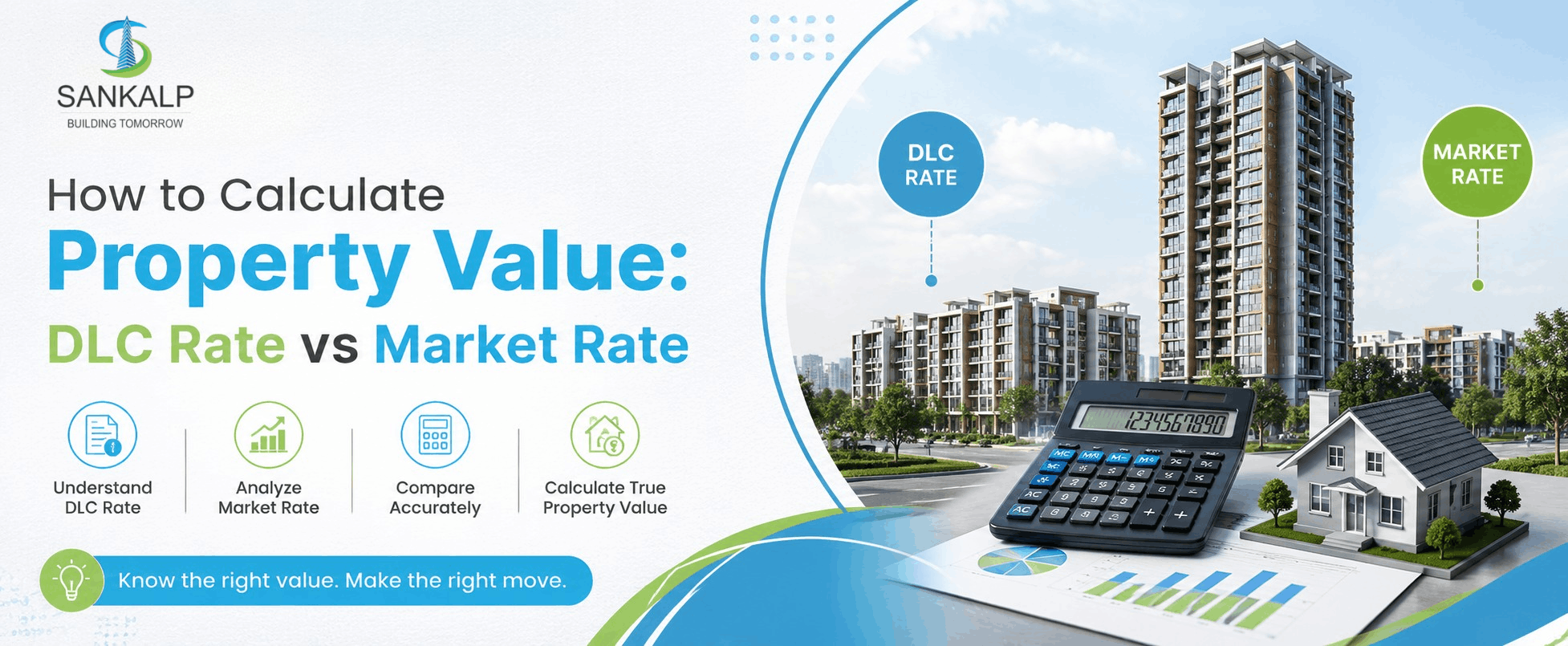
How to Calculate Property Value: Understand Jaipur's DLC and Market Rates
Before you buy any property, you should know how to calculate property value. The price you agree with the seller is not the only number that matters. In Rajasthan, every property has two values. One is the DLC rate, set by the government. The other is the market rate, which is the real price people pay. If you do not understand the difference, you may get a shock at the registration office when the bill is bigger than you expected. This guide explains both values in a simple way, and shows you how the final value is worked out.
If you are looking at apartments in Jaipur or a plot of land, knowing these two rates helps you plan your money better. The rates here are the current ones for Rajasthan. The government changes them from time to time, so always check the latest number before you register your property.
What Is the DLC Rate? The Government's Minimum Value
DLC means District Level Committee. The DLC rate is the lowest value the government allows for a property in a certain area. You cannot register a property below this rate. Other states call it the circle rate or guidance value. Even if you and the seller agree on a lower price, the property still cannot be registered below the DLC rate.
Why does this rate exist? It stops people from showing a very low price on paper just to pay less stamp duty. It keeps things fair and protects the government's income. The DLC rate is different for each area. It can even change from one street to the next.
What Is the Market Rate? The Real Price People Pay
The market rate is the actual price a buyer and seller agree on. It depends on demand, location, the project, the floor, the view, and how the market is doing at that time. Unlike the DLC rate, the market rate keeps changing with demand.
In good, well-developed areas, the market rate is usually higher than the DLC rate. This is because people want to live there, so prices go up. In new or slow areas, the two rates can be close to each other. To find the market rate, check what nearby properties recently sold for, or ask local property agents. The market rate tells you if a price is fair. The DLC rate tells you the lowest value the government will tax you on.
DLC Rate vs Market Rate: The Main Difference
Here is the key point. Both rates appear on your cost sheet, and here is how they differ:
- DLC rate: the fixed minimum value set by the government. Used to work out stamp duty.
- Market rate: the real price you agree to pay. This is what actually goes to the seller.
Now the most important rule to remember: stamp duty and registration charges are always charged on the higher of the two, the DLC value or your agreed price. So if you get a great deal below the DLC rate, you still pay stamp duty on the higher DLC value, not your lower price. Many first-time buyers do not know this, and it surprises them.
Exterior vs Interior DLC Rate: What Is the Difference?
The same area can have two different DLC rates. It depends on where your plot is compared to the main road:
- Exterior DLC rate: for properties next to or facing the main road. This rate is higher, because road-facing plots are worth more.
- Interior DLC rate: for properties inside the area, away from the main road. This rate is lower.
This applies to both homes and shops or offices. When you look up a rate, use the one that matches where your plot actually is. If you use the exterior rate for an interior plot, or the other way around, you will get the wrong value. The width of the road and how much your plot faces it decide which rate you get.
How to Calculate Property Value Using the DLC Rate
Once you have the right rate, the maths is easy. The simple formula is:
Property value = DLC rate (per unit of area) × total area of the property
For example, say the DLC rate for a home is Rs 3,000 per sq. ft. and your flat is 1,000 sq. ft. Then the minimum value is Rs 3,000 × 1,000 = Rs 30,00,000. This is the base value used for stamp duty, unless your actual price is higher. If your price is higher, that higher price is used instead.
For flats and apartments, the rules use the built-up or carpet area, plus any extra factors the committee adds for the type of construction. For land, the plot area is used. Since the rate changes from street to street, always get the current DLC rate for your exact area before you do the sum.
How to Calculate Stamp Duty on Property Value
After you know the higher value (DLC or sale price), you add stamp duty on top. In Rajasthan, the current charges are:
- Stamp duty: 6% for male or joint buyers, 5% for a single female buyer
- Labour cess: 20% of the stamp duty amount
- Registration fee: 1% of the value, same for everyone
Adding it all up, the total comes to about 8% for men and about 7% for women. This is charged on the higher of the DLC value or the sale price. These rates can change, so treat them as the current numbers, and check the live figures on the e-Panjiyan portal when you register.
Why Did the Government Increase the Rates?
The government updates DLC rates every year, usually from 1 April. On 1 April 2026, rates went up by about 10% across Rajasthan. The rise was not the same everywhere, some fast-growing areas went up more than older areas. The government does this to keep the official rate closer to real market prices, which had gone well above the old DLC rates in many places.
For buyers, the lesson is simple: a DLC rate you saw last year may already be higher now. Since the rate can change every April, always check the current number before you plan your budget. Higher DLC rates also mean slightly higher stamp duty, so it pays to use the latest figures.
Why This Matters When Buying in Jaipur
If you are comparing flats in Jaipur, understanding both rates saves you money and stress. A property that looks cheap can still have a big stamp duty bill if its DLC rate is high. And a home priced above the DLC rate simply means your duty is worked out on that market price. Either way, you do not want surprises on registration day.
Buying from good developers also helps. Many of the top builders in Jaipur set clear prices and give clean paperwork, so the price you pay and the value you register make sense together. You can also check a project on the RERA site to confirm it is registered and approved. This keeps your valuation, loan, and registration smooth from start to end.
FAQs
- What is the formula for calculating property value?
Multiply the DLC rate per unit of area by the total area of the property. For registration, stamp duty is then charged on the higher of this DLC value or your actual sale price. - Which value is used for registration, DLC or market rate?
The higher one. If your sale price is above the DLC value, stamp duty is charged on the sale price. If the DLC value is higher, it is charged on that, even if you paid less. - What is the difference between stamp duty value and market value?
The stamp duty value is the DLC rate, the government's minimum for registration. The market value is the real price you agree to pay. They can be different, and stamp duty is always charged on the higher one. - How can I estimate the value of my property?
Find the current DLC rate for your exact area, check whether the exterior or interior rate applies, and multiply it by your area to get the minimum value. Then compare that with recent local sale prices to judge the market value.

Anil Shah
The Anil Shah editorial team writes about Jaipur real estate - market trends, home-buying guides, RERA updates and investment insights - drawing on 25+ years of building landmark residential and commercial projects across the city.
.png)
Looking for your dream property in Jaipur?
Explore RERA-certified homes & commercial spaces by Sankalp Group. Book a free site visit today.