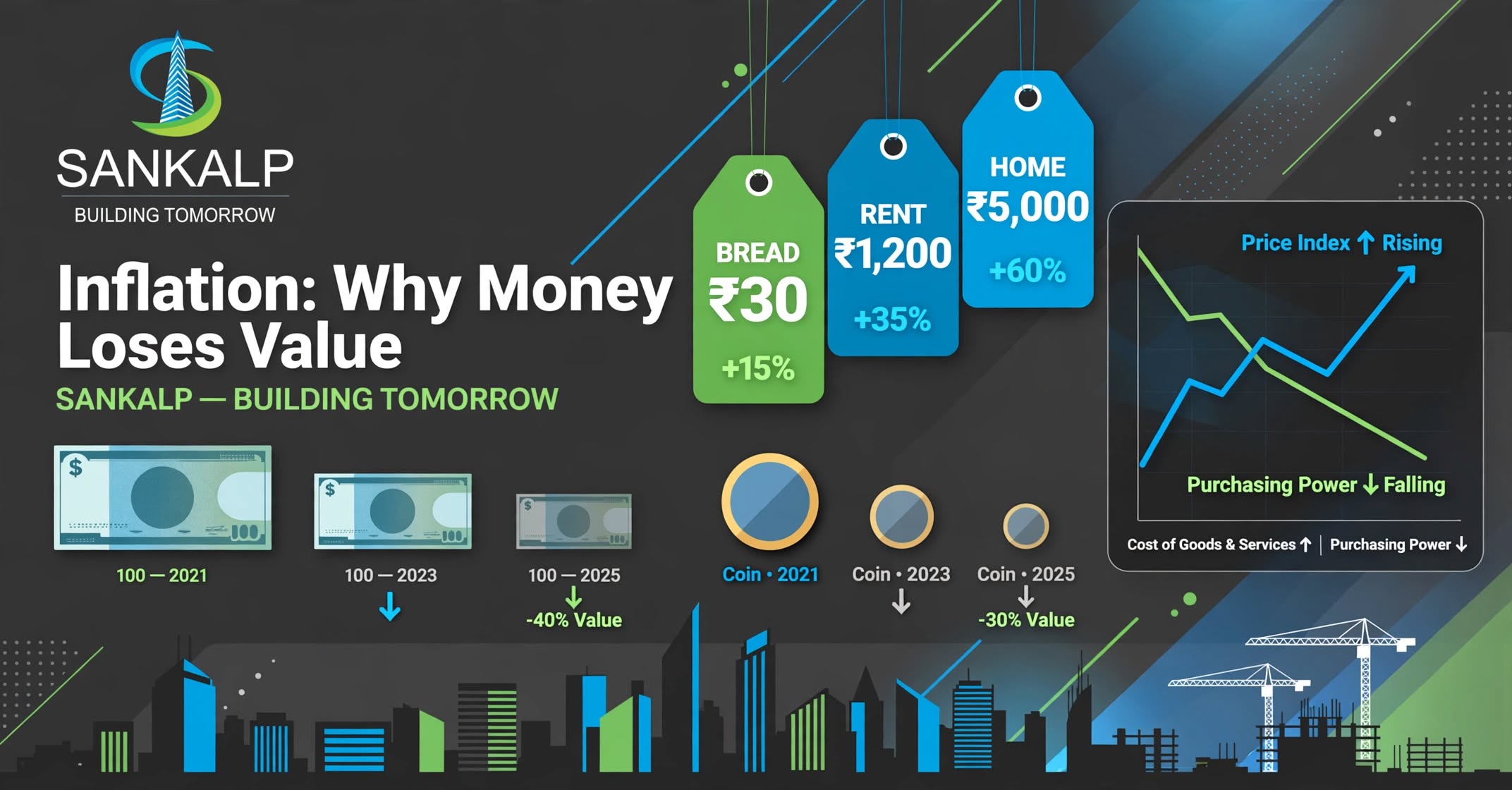
What Inflation Really Means for Your Money
Think back to when you were a child. A chocolate cost a few rupees, a cinema ticket was cheap, and a full bag of vegetables cost very little. Today, the same things cost much more. The chocolate did not get bigger. Your money simply buys less than it used to. That quiet change has a name: inflation.
Inflation affects every family, every day, whether we notice it or not. In a recent Sankalp Group podcast, the founder of the group made a simple but powerful point: inflation kills money that sits idle. He also explained why many real estate investors use home loans to stay ahead of rising prices. This article explains inflation in simple words, shares the latest inflation rate in India, and walks through the ideas from the podcast.
Inflation Meaning in Simple English
If you are looking for the inflation meaning in English, here it is in one line: inflation is the rise in the prices of goods and services over time, which means the same amount of money buys fewer things.
For example, if a packet of milk costs ₹60 today and ₹63 next year, its price has gone up by 5 percent. If your income and savings do not grow by at least that much, you are actually becoming a little poorer every year, even though the number in your bank account stays the same.
Inflation Meaning in Economics
In economics, inflation is measured as the percentage increase in the general level of prices across an economy over a period of time, usually one year. It is not about one item getting costly. It is about the overall cost of living going up.
The inflation meaning in economics also connects to purchasing power. Purchasing power is how much you can buy with a fixed amount of money. When inflation rises, purchasing power falls. That is why economists say inflation is like a hidden tax on money that is kept idle.
Inflation Rate Meaning: How It Is Measured in India
The inflation rate meaning is simple. It tells you how fast prices are rising, shown as a percentage. An inflation rate of 6 percent means that, on average, things cost 6 percent more than they did a year ago.
In India, retail inflation is measured using the Consumer Price Index, or CPI. The government tracks the prices of a fixed basket of everyday items, like food, fuel, clothes, rent, transport, education and healthcare, and compares them with the same month last year. Since February 2026, India uses a new CPI series with 2024 as its base year, which also tracks newer spending such as online shopping and digital services.
Current Inflation Rate in India
According to the latest data released by the Ministry of Statistics and Programme Implementation (MoSPI) on November 12, 2026, the current inflation rate in India is 6.09 percent for October 2026. This is up from 5.54 percent in September.
This latest inflation rate is important for two reasons. First, it has crossed the Reserve Bank of India's upper limit of 6 percent for the first time in two years. The RBI aims to keep inflation at 4 percent, with a comfort band of 2 to 6 percent. Second, food inflation rose even faster, to 8.94 percent, which means families are feeling the pinch most in their kitchen budgets.
The RBI had already raised its repo rate to 5.50 percent in October 2026 to help control rising prices. When the repo rate goes up, loans can become a little more expensive, which slows down spending and helps cool prices over time.
Inflation Calendar: When Is New Data Released?
Many people search for an inflation calendar to know when the next figures will come out. In India, MoSPI releases the CPI inflation data on the 12th of every month at 4 PM, covering the previous month. If the 12th is a holiday, it is released on the next working day.
So, the inflation figure for November 2026 is expected on December 12, 2026. Keeping an eye on this monthly release helps you understand where prices, interest rates and loan EMIs may be heading.
Types of Inflation
Not all inflation is the same. Economists describe different types of inflation based on why prices rise and how fast they rise.
Demand-pull inflation happens when people want to buy more than what is available. When demand is higher than supply, prices go up.
Cost-push inflation happens when the cost of making things rises, such as fuel, raw materials or wages. Companies then pass these higher costs on to buyers.
Built-in inflation happens when people expect prices to keep rising, so workers ask for higher wages, and businesses raise prices again to cover those wages. This creates a cycle.
Based on speed, inflation can also be creeping (slow and mild), walking (moderate), galloping (very fast), or hyperinflation, where prices rise so quickly that money loses almost all its value.
Inflation and Deflation: What Is the Difference?
Inflation and deflation are opposites. Inflation means prices are going up and money is losing value. Deflation means prices are falling and money is gaining value.
Deflation may sound good at first, but long periods of falling prices can be harmful. People delay buying, hoping prices will fall further. Businesses earn less, and jobs can be affected. This is why most central banks, including the RBI, aim for low and steady inflation rather than zero or falling prices.
Inflation Calculator: See How Your Money Shrinks
An inflation calculator shows how much your money will be worth in the future. You can do a simple version yourself.
If inflation stays at 6 percent a year, something that costs ₹100 today will cost about ₹106 next year. A useful shortcut is the Rule of 72: divide 72 by the inflation rate to find how many years it takes for prices to double. At 6 percent, prices roughly double in about 12 years. That means ₹10 lakh kept idle today may buy only about half as much in 12 years.
This is exactly why keeping all your savings in cash or a low interest account can quietly reduce their value over time.
How to Protect Your Money From Inflation
The goal is simple: your money should grow faster than prices. Families usually look at a mix of options for this, such as mutual funds for long term goals, fixed income options for safety, and property, because land and building costs, as well as rents, tend to rise over time along with inflation.
Why Many Property Investors Use a Home Loan
In the podcast, one idea stood out. Instead of paying the full price of a property from their savings, many experienced investors use a home loan. The reason is simple: a loan increases how much you can buy.
Here is the example shared in the podcast. If you put in ₹25 lakh of your own money, a bank may give you a home loan of around ₹75 lakh.
Together, that lets you buy a property worth about ₹1 crore. So when the value of the property grows, the growth is on the full ₹1 crore, not just on the ₹25 lakh you paid.
Now compare that with keeping ₹1 crore in a bank. If inflation is 6 to 7 percent, that money will have the buying power of only about ₹93 lakh after one year. This is why the podcast points out that big business players borrow money. When prices keep rising, money that sits still loses value, while a well chosen asset can grow along with inflation.
Following the same thinking, someone with ₹1 crore could use it as the down payment, ₹25 lakh each, on four properties instead of buying just one property in full. According to the podcast, this is how many people have built wealth in real estate.
Things to Check Before Taking a Home Loan
A loan increases your buying power, but it also increases your responsibility. Here are a few things to keep in mind before you borrow.
Losses can also be bigger. If a ₹1 crore property rises in value by 10 percent, you gain ₹10 lakh. But if it falls by 10 percent, you lose ₹10 lakh, and the loan still has to be repaid in full.
EMIs must fit your income. Every loan comes with a monthly EMI. Make sure you can pay it comfortably, even in a month when rent does not come in or your income is lower.
Interest rates can change. The RBI raised its repo rate to 5.50 percent in October 2026. When rates go up, EMIs on floating rate home loans can rise too.
Banks do not lend the full price. For bigger loans, banks usually finance up to about 75 percent of the property's value. Stamp duty, registration and other charges usually have to be paid from your own pocket.
More properties mean more loans. Buying several properties with loans spreads your money, but it also multiplies your EMIs and your risk. Keep an emergency fund aside and never borrow more than you can handle.
Before making any big decision, speak to a qualified financial advisor and your bank about what is right for your situation.
Inflation and Real Estate in Jaipur
Real estate is often discussed as a way to stay ahead of inflation. When prices rise across the economy, the cost of land, cement, steel and labour also rises, and this often pushes up property values. Rents tend to move up as well, which helps property owners keep their income in line with rising costs.
This is one reason why real estate in Jaipur continues to draw interest from both families and investors. Flats in Jaipur and apartments in Jaipur are bought not only as homes but also as long term assets. In established areas, homes such as 3 BHK flats in Vaishali Nagar are popular with families who want space and a stable investment. Business owners and investors also look at commercial property for rent in Jaipur, as rental income from shops and offices can rise over time.
As with any property purchase, location, legal checks and the builder's track record matter just as much as the price.
Watch the Full Podcast
To hear a deeper discussion on money, inflation and why understanding wealth creation matters today, watch the full Sankalp Group podcast below.
Final Thoughts
Inflation is not something we can stop, but it is something we can plan for. With the current inflation rate in India above 6 percent, money that sits idle in a bank quietly loses value year after year. As the podcast explains, the key is to put money into assets that can grow along with inflation, and for many property investors, a carefully planned home loan is part of that plan.
Understanding the inflation meaning, keeping track of the latest inflation rate, and choosing ways for your savings to grow faster than prices can make a real difference to your family's future. Start small, stay informed, and make your money work as hard as you do.
Frequently Asked Questions
What is inflation in simple words?
Inflation is the rise in the prices of goods and services over time. When prices go up, the same amount of money buys fewer things. For example, if milk costs ₹60 today and ₹63 next year, your money has lost some of its buying power.
What is the current inflation rate in India?
According to data released by MoSPI on November 12, 2026, India's retail inflation was 6.09 percent in October 2026. This is above the RBI's upper limit of 6 percent. New inflation data is released on the 12th of every month.
How does inflation affect money kept in a bank?
Money that sits idle loses value when prices rise faster than the interest it earns. If inflation is 6 to 7 percent, ₹1 crore kept in a bank will have the buying power of only about ₹93 lakh after one year.
Why do many property investors use a home loan?
A home loan increases how much you can buy. With ₹25 lakh of your own money and a loan of around ₹75 lakh, you can buy a property worth about ₹1 crore, so any rise in value is on the full ₹1 crore. But losses are also bigger, so make sure the EMIs fit your income and speak to a financial advisor before borrowing.

Anil Shah
The Anil Shah editorial team writes about Jaipur real estate - market trends, home-buying guides, RERA updates and investment insights - drawing on 25+ years of building landmark residential and commercial projects across the city.


Looking for your dream property in Jaipur?
Explore RERA-certified homes & commercial spaces by Sankalp Group. Book a free site visit today.