RERA Rules in Rajasthan: A Guide for Builders and Homebuyers
RERA rules form the backbone of a safe property transaction in India, setting out exactly what a builder must do and what a buyer is entitled to. Introduced under the Real Estate (Regulation and Development) Act, 2016, these rules cover registration, buyer funds, possession, carpet area and much more. This guide explains the key rules in plain language, for both builders and homebuyers in Rajasthan, so you understand your obligations and your protections before you sign anything.
What Are RERA Rules?
RERA rules are the legal requirements set under the Real Estate (Regulation and Development) Act, 2016, and the state rules made under it. Together they govern how developers register, market, build and hand over projects, and how buyers are protected at each stage.
Each state notifies its own version of these rules within the national framework. In Rajasthan, the state authority enforces them through the RERA Rajasthan portal, where projects and agents are registered and buyers can verify details.

Why RERA Guidelines Matter
Before this law, the property market ran with little oversight, and buyers carried most of the risk. The rera guidelines changed that balance in a few important ways.
- They bring transparency to how projects are sold
- They protect buyer money through strict financial rules
- They set clear timelines and quality standards
- They give buyers a fast route to complain and seek redress
For anyone buying flats in Jaipur or elsewhere in the state, these protections now come as standard.
Key RERA Rules for Builders
Developers carry the bulk of the obligations. The main rera rules for builders include:
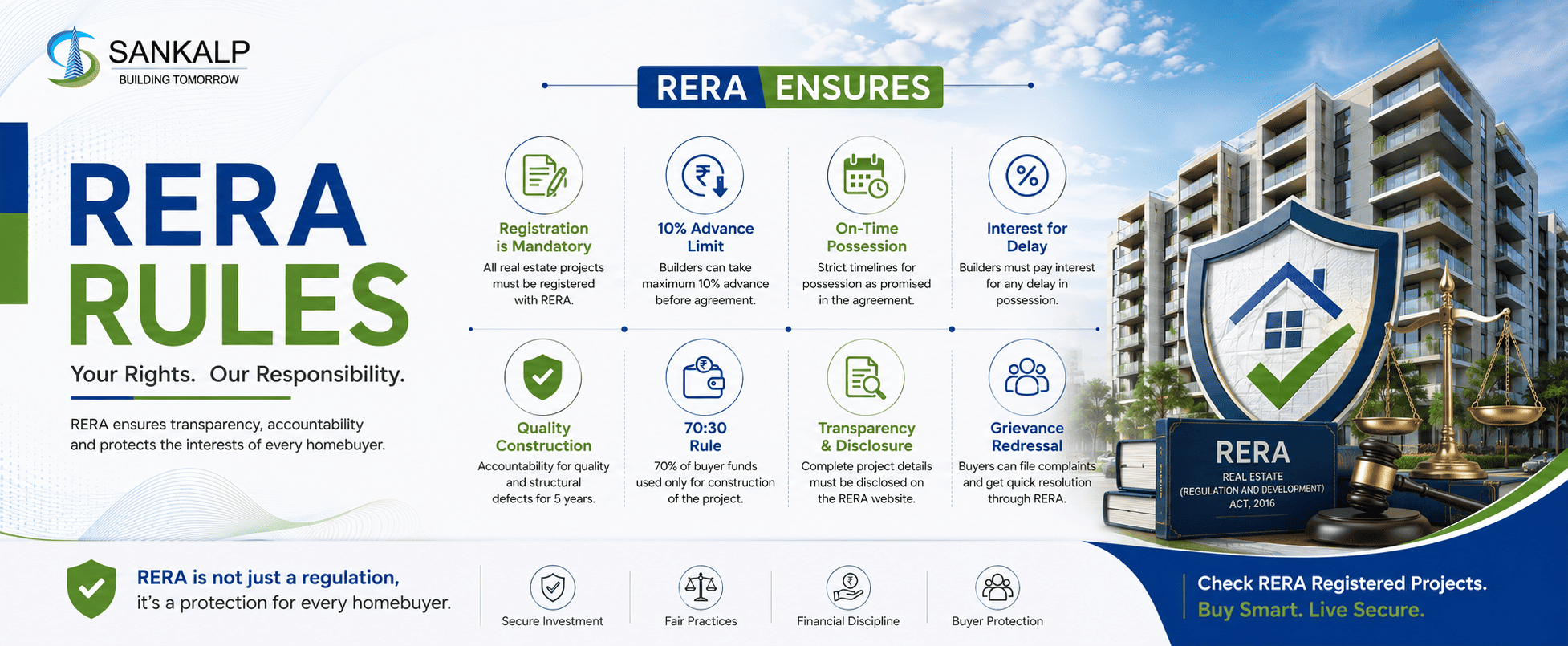
- Registration: projects above 500 square metres or with more than 8 units must register before marketing or sale
- Honest disclosure: the approved plan, timeline and project details must be declared and kept updated
- The 70 percent rule: most buyer funds must sit in a dedicated project account
- Carpet area selling: homes must be sold on carpet area, not inflated super built-up area
- Timely possession: builders owe interest for handover delays
- Quality liability: under Section 14(3), structural or workmanship defects must be fixed free of charge for five years after possession
- Title transfer: the builder must execute the conveyance deed and hand over as required
These building norms reward serious developers and push out unreliable ones.

Key RERA Guidelines for Buyers
Buyers gain a clear set of rights, and a few duties too. The rera guidelines for buyers include:
- The right to accurate project information before buying
- The right to buy on carpet area, paying for usable space
- The right to timely possession, with interest for delays
- The right to structural defect repairs for five years, with fixes due within 30 days of notice
- The duty to make payments on the agreed schedule
- The duty to take part in the conveyance and society formation
Knowing these rera guidelines for apartments helps a buyer act with confidence rather than trust alone.

The 70 Percent Rule Explained
One of the most important rera provisions concerns money. A developer cannot freely spend everything buyers pay.
- 70 percent of the funds collected from buyers must go into a dedicated project account
- This money can be used only for the construction and land cost of that project
- The remaining 30 percent covers other approved expenses
This is the RERA 70 rule, and its purpose is simple: to stop builders diverting your money to other projects, which was once a major cause of stalled homes.
RERA Rules for Payment Schedule and Carpet Area
Two everyday rules protect buyers at the point of purchase. Under the rera payment rules, a builder cannot demand more than 10 percent of the cost as an advance before a written, registered agreement is signed. Payments after that follow the agreed schedule, usually tied to construction stages.
On measurement, the carpet area rule requires pricing on the actual usable floor area within your walls, not the loosely defined super built-up area. This single rule ended a long-standing practice of buyers paying for space they could never use.
RERA Rules for Delayed Possession
Delays were once the biggest grievance in real estate. Section 18 of the Act gives buyers real protection, and it is one of the strongest features of the law. If a builder fails to hand over by the promised date, the buyer gets a clear choice.
| Option | What the buyer gets |
|---|---|
| Continue with the project | Interest for every month of delay until possession is handed over |
| Withdraw from the project | A full refund of the amount paid, with interest from the date of each payment |
The interest rate is set by the state rules, most commonly the State Bank of India's highest MCLR plus 2 percent, which works out to roughly 10 to 11 percent in most states. A key fairness point runs through this: the same rate applies both ways. If a buyer delays a payment, the builder charges this rate, and if the builder delays possession, they must pay the buyer at exactly the same rate. This symmetry ended the old imbalance, where buyers were charged high interest for late payment but offered almost nothing for a builder's delay.
RERA Rules for Society Handover
Once a project is complete, the society handover norms guide the transition to the residents. Under Section 17 of the Act, the promoter must execute a registered conveyance deed in favour of the buyers and, where local law is silent, do so within three months of receiving the occupancy certificate. The builder must also hand over the common areas and documents to the residents' association. This ensures buyers gain proper legal ownership and control of their community.
Penalties Under RERA
The rera regulations carry real consequences for breaches.
- A builder who fails to register can face a penalty of up to 10 percent of the project cost, and imprisonment for continued default
- Ignoring an order of the authority or tribunal brings further penalties
- Buyers and agents who default face their own penalties
State authorities aim to pass orders on a complaint within about 60 days, and a RERA order is enforceable like a decree of a civil court, even recoverable as arrears of land revenue. These teeth are what turn the rera norms from words into real obligations, and they apply across the country, including to developers of property in Jaipur.
How RERA Norms Connect With Other Property Checks
RERA is one layer of protection, and it works best alongside your own checks. Verify the RERA number on the state portal, confirm the title and approvals, and check the DLC rate in Jaipur to understand the minimum registration value and your likely stamp duty. Buyers comparing options, from apartments in Jaipur to flats in Jagatpura, should treat RERA verification and these checks as a single routine before booking.
Choosing a RERA-Compliant Builder
For a buyer, a developer's RERA record is a strong signal of trust. Among the top builders in Jaipur, those with a clean set of registered, compliant projects show they take the rules seriously. Ask any builder for the RERA number, verify it yourself, and read the project details on the portal. A genuine developer will welcome the check, since compliance is part of how they earn buyer confidence.
Conclusion
RERA rules protect the two things that matter most in a property deal: your money and your home. They require builders to register, disclose honestly, ring-fence funds, sell on carpet area, deliver on time and transfer title properly, while giving buyers clear rights and a fast path to justice. Understanding these rules turns a major purchase into an informed decision. Whether you build or buy, knowing the rules of RERA keeps you on solid ground.
FAQs
1. What is the RERA 70 rule?
The RERA 70 rule requires a developer to deposit 70 percent of the money collected from buyers into a dedicated project account. This money can be used only for that project's construction and land cost, which prevents funds from being diverted to other projects.
2. What is rule 17 of the RERA Act?
Section 17 of the RERA Act deals with transfer of title. It requires the promoter to execute a registered conveyance deed in favour of the buyer and, in the absence of local law, to do so within three months of receiving the occupancy certificate, transferring ownership and common areas properly.
3. What are the RERA rules in Rajasthan?
Rajasthan follows the national framework through RERA Rajasthan. Projects above 500 square metres or with more than 8 units must register, buyer funds are ring-fenced, homes are sold on carpet area, possession delays attract interest, and buyers can verify projects on the state portal.
4. What is the RERA penalty?
A builder who fails to register a project can face a penalty of up to 10 percent of the project cost, with imprisonment for continued default. Ignoring an order of the authority or tribunal can attract further penalties, including imprisonment.

Anil Shah
The Anil Shah editorial team writes about Jaipur real estate - market trends, home-buying guides, RERA updates and investment insights - drawing on 25+ years of building landmark residential and commercial projects across the city.
Looking for your dream property in Jaipur?
Explore RERA-certified homes & commercial spaces by Sankalp Group. Book a free site visit today.