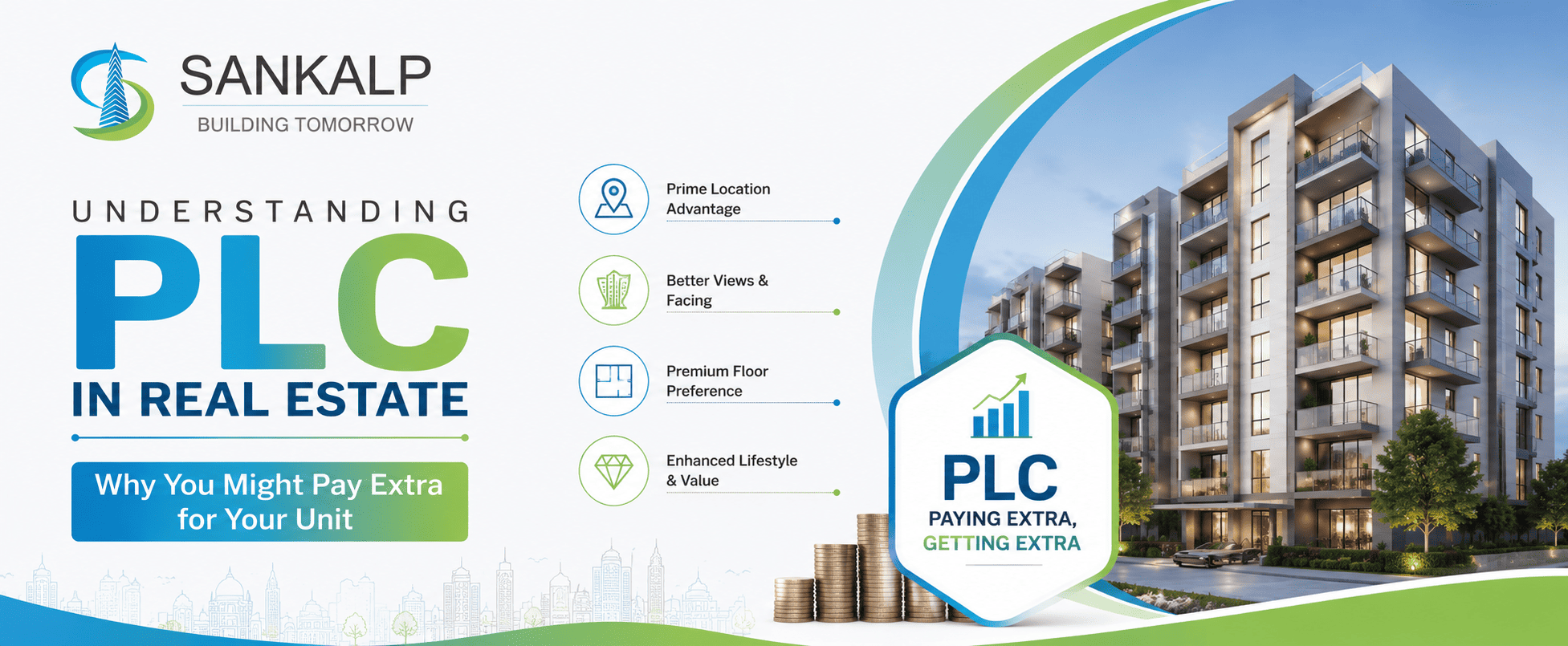
Understanding PLC in Real Estate: Why You Might Pay Extra for Your Unit
You choose a flat. The builder tells you the rate is 5,500 rupees per square foot. Then the cost sheet comes. Your flat is billed at 5,775 per square foot. The size did not change. The building did not change. So why did the price go up?
You have met PLC in real estate. It is the extra money a builder charges when your flat is in a better spot than the other flats.
This one line confuses buyers more than anything else in a cost sheet. Some people pay it quietly. Some people fight it without knowing what it is. Both lose money.
This guide explains PLC in real estate in easy words. What it is. Why builders charge it. How the amount is worked out. What the law says. And when it is worth paying.
What is PLC in Real Estate?
PLC in real estate full form is Preferential Location Charge. Some builders write PLC Charges full form as Preferential Location Charges. Both mean the same thing.
Here is the simple idea.
Every flat in a tower has the same builder. The same lift. The same guard at the gate. But every flat does not have the same view. Some get more sunlight. Some are far from the noisy road. Some are just nicer to live in.
The builder charges extra money for those better flats.
Think of an aeroplane. Every seat lands at the same time. But a window seat with extra leg space costs more than a middle seat next to the toilet. The flight is the same. The comfort is not. That is the whole idea behind preferential location charges.
PLC Meaning in Real Estate
The plc meaning in real estate becomes clear when you see what it is not.
- It is not a government charge. No tax office collects it.
- It is not a service charge. You are not paying for water, power or cleaning.
- It is not returned to you. Once paid, it becomes part of your flat's price.
- It is a one-time amount. You pay it along with the price of the flat.
PLC in real estate is only the builder's price for a better spot inside the same project. Nothing more.
What Determines PLC in Real Estate?
Two things decide if your flat gets this charge, and how big it will be.
Unit Location
This means where your flat sits inside the project.
- Your floor. Higher floors get better air, less road noise and a longer view.
- The direction your flat faces. A park-facing flat costs more than one facing a boundary wall.
- Corner or not. A corner flat has windows on two sides. More light. Better air flow.
- Distance from the lift. Some buyers want to be near it. Some hate the noise. Both choices get a price.
- Distance from the gate and road. Quiet costs more.
- What you see from the balcony. A garden, pool or clubhouse view carries a premium.
- Vastu direction. Many buyers ask for east or north-east facing flats. So builders charge more for them.
Market Dynamics
The same flat does not carry the same charge every year. The market changes it.
- Demand. If a project is selling fast, the builder raises the charge on good flats. If sales are slow, the charge drops or goes away.
- Time of launch. At launch, all the best flats are open and priced high. Near the end, the leftover good flats become easy to bargain for.
- The project next door. No builder wants to look costly next to a rival one kilometre away.
- How rare the feature is. If only 8 flats out of 200 face the park, the charge is high. If 90 flats face it, the charge is small.
Any honest real estate developer in Jaipur will tell you the truth here. PLC in real estate is a pricing tool. It is not a fixed rule written in a government book.
Types of PLC in Real Estate
Builders use different names, but the types of plc in real estate are few.
| Type of charge | What you pay for | Usual range |
|---|---|---|
| Floor rise charge | Every floor above a set level | 15 to 50 rupees per sq ft per floor |
| Park or garden facing | An open green view | 2 to 6 per cent of base price |
| Corner flat | Two open sides, more light and air | 2 to 5 per cent of base price |
| Pool or clubhouse facing | View of the main facility | 2 to 5 per cent of base price |
| Road facing (shops) | Customers can see your shop | Much higher in shops |
| East or north-east facing | Vastu choice and morning sun | 1 to 3 per cent of base price |
These numbers are what buyers usually see in the market. No law fixes them. They change from builder to builder. Always ask for the real number in writing.
How are PLC Charges Calculated?
The PLC charges in real estate are worked out in one of two ways.
Calculation Methods
Method 1. A rate for every square foot. The builder fixes a rate per square foot and multiplies it by your flat area.
A flat of 1,200 sq ft with a park-facing charge of 200 rupees per sq ft gives you 2,40,000 rupees.
Method 2. A percentage of the base price. The builder takes a percentage of your flat's base cost.
A base price of 60,00,000 rupees with a 3 per cent corner charge gives you 1,80,000 rupees.
One flat can carry more than one charge at the same time. A corner flat on the 12th floor facing the park can carry three charges together. This is how cost sheets grow quietly.
A Simple Example
| Line in the cost sheet | Amount |
|---|---|
| Base price (1,200 sq ft at 5,000 per sq ft) | 60,00,000 |
| Floor rise (12th floor, 25 per sq ft per floor above 3rd) | 2,70,000 |
| Park facing charge (150 per sq ft) | 1,80,000 |
| Corner flat charge (100 per sq ft) | 1,20,000 |
| Total before other charges | 65,70,000 |
That is 5,70,000 rupees of extra charge on one flat. Almost 9.5 per cent above the base price. Worth knowing before you sign.
Understanding Specific Charges
Floor Rise Charges
This is the most common charge in tall buildings. The builder picks a starting floor, usually the third or fourth. Then he adds a fixed amount for every floor above it.
Ask two questions.
Where does the counting start? If it starts from the ground floor and not the fourth, your bill becomes much bigger.
Is there a stopping point? Some builders stop charging after a certain floor. Some do not. That is why top floors of a 20-storey tower can cost several lakh more.
There is one fair point on the builder's side. Higher floors really do cost more to build. Material has to be lifted higher. The structure has to be stronger. So this charge has some real cost behind it.
View Premium
You pay for what you can see. A flat facing a park, a lake, a hill or a garden gets a higher price.
Here is one warning that saves buyers a lot of pain. Find out what is planned on the land your view depends on. If the open ground in front of your tower belongs to someone else, a building can come up there in three years. Your view will go. Your money will not come back.
So ask one simple question. Is that open area inside the project boundary, or outside it?
Proximity to Amenities
Being near the clubhouse, pool or play area is sold as a good thing. For many families it is. Children can go down and come back on their own.
But think about the other side. Being very close to a pool or party lawn also means noise on weekends. Some buyers pay extra and then regret it. Go and stand at that spot at 8 pm on a Saturday before you decide.
Is there a Legal Framework for PLC in India?
No law says how much a builder can charge. That is his business decision. But the law is strict about telling you clearly.
Under RERA. The Real Estate (Regulation and Development) Act, 2016 says the builder must show the full break-up of the total price in the agreement for sale. The location charge is part of that total price. It must be shown as its own line. A builder cannot add it later as a surprise. Every registered project is listed on the RERA site of the state authority. In Rajasthan the agreement format follows the Rajasthan Real Estate (Regulation and Development) Rules, 2017.
On area. RERA says flats must be sold and quoted on carpet area. Carpet area is the space you can actually walk on inside your walls. This matters a lot. The same percentage on super built-up area gives a much bigger bill than on carpet area.
Under GST. This was unclear for years. It is settled now. The 54th GST Council meeting in September 2024 said that location charges paid along with the construction cost, before the completion certificate is given, are part of one bundled supply. Construction is the main service. The location charge goes with it. So both are taxed at the same GST rate. The Punjab and Haryana High Court agreed with this in 2026 in the DLF case, saying the choice of location is part of the construction service and cannot be taxed on its own.
In easy words: your location charge is taxed at the same GST rate as your flat.
Under state stamp law. The charge becomes part of your total sale value. Stamp duty in Rajasthan is 6 per cent for men and joint buyers, and 5 per cent for a woman buying alone. Add a 20 per cent labour cess on the duty and a 1 per cent registration fee. All of it is worked out on the higher of your sale value or the DLC rates fixed for your area. So a big location charge also raises your registry cost. Keep money aside for it.
Comparing PLC with Other Real Estate Charges
A cost sheet has many lines. They are not the same thing. Mixing them up leads to useless arguments with the sales team.
| Charge | What it is | Paid to | One time or monthly |
|---|---|---|---|
| Preferential location charge | Extra for a better spot | Builder | One time |
| Base price | Cost of the flat itself | Builder | One time |
| EDC and IDC | Development charges for roads and services | Builder, passed on | One time |
| Club membership | Use of the clubhouse | Builder or society | Usually one time |
| Parking charge | Your car park space | Builder | One time |
| Maintenance deposit | Advance for upkeep of common areas | Builder or association | One time, then monthly |
| Stamp duty and registration | Government charge on the sale deed | State government | One time |
| GST | Tax on under-construction property | Government, through builder | One time |
Notice the difference. PLC in real estate is the only line here that is about where your flat sits. Every other line would be charged even if all flats were exactly the same.
Pros and Cons of Paying for PLC
| Reasons to pay | Reasons to think again |
|---|---|
| Better light and air every single day | You may not get the full amount back at resale |
| A view that makes daily life nicer | A new building can block your view later |
| Corner and park-facing flats rent out faster | Higher stamp duty and registry cost |
| Good flats always find buyers | High floors are hard when the lift breaks |
| Quiet, away from the road and gate | Some charges are just marketing |
Here is a simple test. Ask yourself if you will notice the benefit every day.
Sunlight and fresh air, you notice daily. A pool view from the 14th floor, you may look at twice a month.
PLC in Commercial vs Residential Real Estate
The rules flip completely when a property earns money instead of housing a family.
| Point | Homes | Shops and offices |
|---|---|---|
| What buyers want | Comfort, light, view, quiet | Customers seeing the shop |
| Best spot | Higher floor, corner, park facing | Ground floor, main road |
| Size of charge | Usually 2 to 10 per cent | Can be 25 per cent or much more |
| What you get back | Comfort, some resale gain | Higher rent and business |
| Floor rule | Higher is better | Lower is better |
See how it reverses. In a housing tower, the top floor is the prize. In a shopping complex, the ground floor shop on the main road is the costliest unit in the building. The same size shop upstairs may sell for less than half.
The reason is simple. A shop earns from customers walking in. Customers rarely climb stairs.
If you are buying property in Jaipur to earn rent and not to live in, do the maths first. Ask what a normal unit rents for. Ask what the premium unit rents for. See if the extra rent covers the extra cost.
Practical Advice Before You Pay
- Ask for the charge as a separate line. One lumped figure is a warning sign.
- Ask which area is used. Carpet area or super built-up area changes the amount a lot.
- Go to your actual floor. Not the sample flat on the second floor.
- Check the master plan. See what is coming up on the land near your view.
- Compare with a normal flat. The price gap is what you are really paying.
- Bargain at the right time. End of a quarter, last unsold flats, or a slow market.
- Get an encumbrance certificate. Before you pay anything, take an encumbrance certificate to check that no loan or legal claim is registered on the property.
- Read the agreement. The charge must be written in the agreement for sale, not only in a brochure.
When you look at flats in Jaipur, and especially ready to move flats in Jaipur where the building is already standing, you have a big advantage. You can go up. Stand in the real flat. Look out of the real window. Then decide if the view is worth the money. Buyers of under-construction flats can only trust a drawing.
Conclusion
PLC in real estate is not a cheat. It is also not a fixed rule. It is a price put on a real difference between two flats in the same building.
Sometimes that difference is worth good money. Sometimes it is just a nice sounding reason to charge more for a flat that is barely different.
Your job is to tell the two apart. Stand in the flat. Look out of the window. Ask what will come up on that open land. Compare with a normal flat in the same tower. Then decide.
Buyers who check apartments in Jaipur this way pay extra only where it is worth it. That one habit can save a few lakh rupees, or make sure a few lakh rupees are well spent.
Frequently Asked Questions
-
How to calculate PLC in real estate?
Two ways are used. Either a fixed rate per square foot multiplied by your flat area, or a percentage of the base price. A 1,200 sq ft flat with a park-facing rate of 200 rupees per sq ft gives 2,40,000 rupees. One flat can carry more than one charge, so add them all before you compare options. -
What is a PLC unit in flats?
It is a flat that the builder has marked as better placed than the others in the same project, and priced higher for it. Common examples are corner flats, park-facing flats, higher floors, and flats with a pool or clubhouse view. -
What is floor PLC in real estate?
Floor PLC, also called floor rise charge, is the extra amount added for every floor above a chosen starting floor. At 25 rupees per sq ft per floor from the fourth floor upward, a 1,200 sq ft flat on the tenth floor gets 25 x 6 x 1,200, which is 1,80,000 rupees. -
What is PLC in a loan?
The short form means something else in banking. This location charge is not a separate loan. Banks add it to the total cost of the flat while working out your loan amount, as long as it is properly written in your agreement and cost sheet. If a builder takes it in cash without any paper, your bank will not fund that part. -
Is PLC negotiable?
Often yes. The builder decides it, not the government, so there is room to talk. You are strongest in a slow market, at the end of a sales quarter, when few good flats are left, or when you pay a bigger amount upfront. Ask for this charge to be dropped rather than asking for a cut in the base price. Builders protect their headline rate. -
How does PLC affect property resale value?
A good spot usually helps when you sell. Corner flats, higher floors and park-facing flats sell faster and get better offers. But you rarely get the full amount back as a separate sum, because the next buyer values the flat as one whole thing. Treat it as comfort you enjoy while living there, with some resale gain attached. -
Can PLC charges change after purchase?
No, not once it is written in your agreement for sale. The amount is fixed at booking and forms part of the total price shown under RERA. A builder cannot raise it later because the market improved. If a demand letter shows a bigger figure than your agreement, write to the builder at once. -
Is PLC calculated by carpet or built area?
It depends on the builder, and it matters a lot. RERA says flats must be sold and quoted on carpet area, which is the usable space inside your walls. Some builders still work the charge out on super built-up area, which is bigger and gives a bigger bill for the same percentage. Ask which area is being used and get it in writing. -
What features commonly attract a PLC?
Higher floors, corner position, park or garden facing, pool or clubhouse view, east or north-east facing for vastu, distance from the main road and gate, and in shops and offices, ground floor units facing the main road.

Anil Shah
The Anil Shah editorial team writes about Jaipur real estate - market trends, home-buying guides, RERA updates and investment insights - drawing on 25+ years of building landmark residential and commercial projects across the city.


Looking for your dream property in Jaipur?
Explore RERA-certified homes & commercial spaces by Sankalp Group. Book a free site visit today.