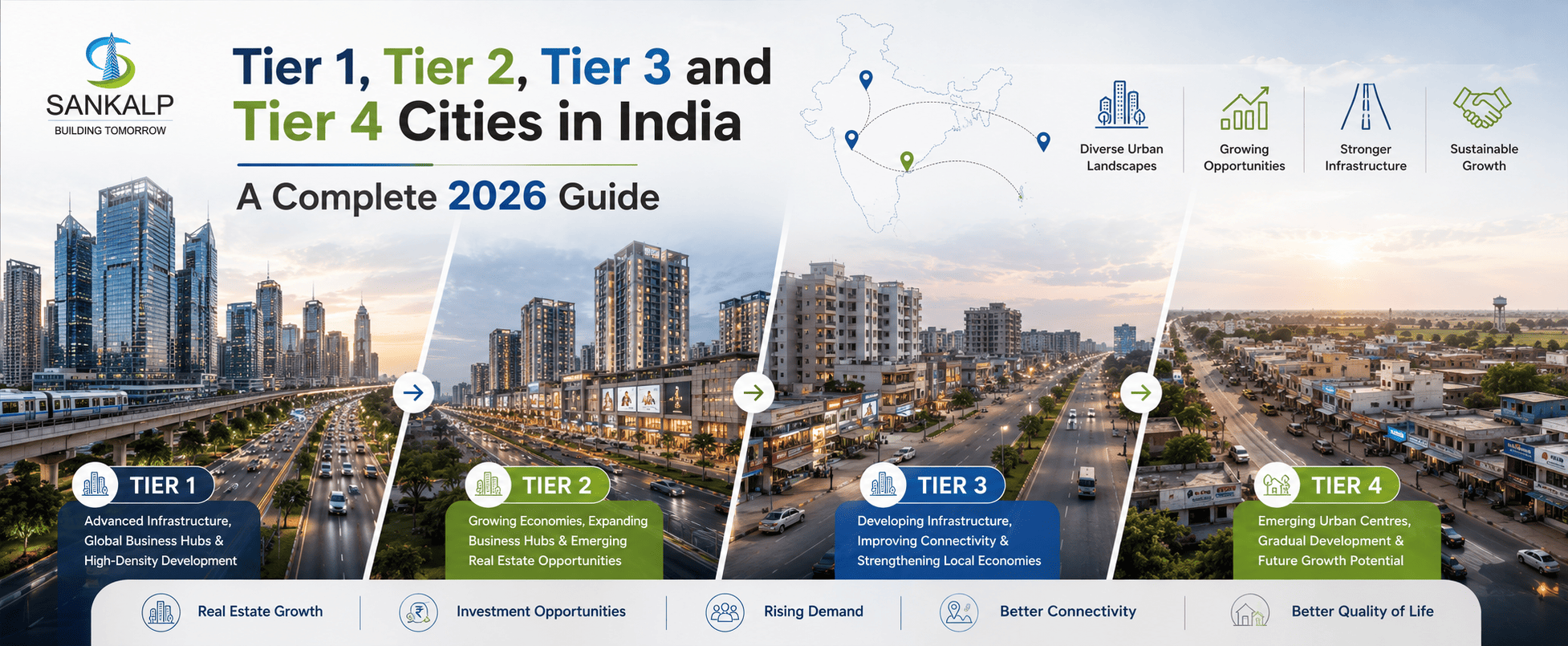
If you follow property or business news, you hear cities called Tier 1 or Tier 2 constantly. What most people do not realise is that there is no single official Government of India list that ranks every city as Tier 1, 2, 3 or 4. Several different systems exist, run by different bodies for different purposes, and everyday usage blends them together. This guide explains each system clearly, using verified government sources, and shows what the labels actually mean for property buyers.
The Most Important Thing to Understand First
"Tier 1, Tier 2, Tier 3, Tier 4" is not one official classification used uniformly across the Government of India. It is a popular shorthand that borrows from more than one real system.
Two official classification systems genuinely exist:
- The Government's HRA classification, which sorts cities into X, Y and Z, run by the Ministry of Finance
- The Reserve Bank of India's population-based tiers, which run from Tier 1 to Tier 6
On top of these, the popular business and real estate use of "Tier 1/2/3/4" is an informal convention, not a government notification. Recognising this saves you from treating a marketing label as an official fact.
System 1: The Government HRA Classification (X, Y, Z)
This is the classification most people mean when they say Tier 1 or Tier 2.
The Government of India classifies cities into X, Y and Z categories to decide House Rent Allowance for central government employees. The system is administered by the Department of Expenditure under the Ministry of Finance, and it is based on population, following the recommendations of the Central Pay Commissions.
- X, Y and Z are popularly known as Tier 1, Tier 2 and Tier 3
- There are eight X-class cities and around 97 Y-class cities
- Every other town falls into the Z class
- HRA is paid at 30 percent, 20 percent and 10 percent of basic pay for X, Y and Z respectively
Two cities, Pune and Ahmedabad, were upgraded from Y to X on 1 April 2014, based on the 2011 Census. This shows the list is revised over time rather than fixed.
The eight X-class (Tier 1) cities
The population figures below are from the 2011 Census, the most recent completed national census, since Census 2021 was postponed. Two figures are shown: the city proper (municipal corporation) and the wider urban agglomeration, because the two can differ by a wide margin.
| Tier 1 / X-class city | State | City population (2011 Census) | Urban agglomeration (2011 Census) |
|---|---|---|---|
| Mumbai | Maharashtra | 1,24,42,373 | 1,84,14,288 |
| Delhi | Delhi (NCT) | 1,10,34,555 | 1,63,14,838 |
| Bengaluru | Karnataka | 84,43,675 | 84,99,399 |
| Hyderabad | Telangana | 67,31,790 | 77,49,334 |
| Ahmedabad | Gujarat | 55,77,940 | 63,52,254 |
| Chennai | Tamil Nadu | 46,46,732 | 86,96,010 |
| Kolkata | West Bengal | 44,96,694 | 1,41,12,536 |
| Pune | Maharashtra | 31,24,458 | 50,49,968 |
These eight are what popular media calls India's "metros". Figures are from the Census of India 2011 (Registrar General and Census Commissioner). The city and urban agglomeration figures measure different areas, which is why Kolkata's city figure looks small while its agglomeration is among the largest. Source for classification: Department of Expenditure, Ministry of Finance.
System 2: The Reserve Bank of India Tiers (Tier 1 to Tier 6)
The RBI uses a completely separate system, sorting centres into six tiers purely by population. This is used for banking and demographic purposes, not for city prestige or allowances, and its thresholds are far smaller than most people assume.
| RBI Tier | Population (2001 Census basis) |
|---|---|
| Tier 1 | 100,000 and above |
| Tier 2 | 50,000 to 99,999 |
| Tier 3 | 20,000 to 49,999 |
| Tier 4 | 10,000 to 19,999 |
| Tier 5 | 5,000 to 9,999 |
| Tier 6 | Less than 5,000 |
Notice the gap. Under the RBI system, a city of 100,000 people is Tier 1, whereas in popular real estate usage Tier 1 means only the eight biggest metros. The two systems use the same words for very different things. Source: Reserve Bank of India.
Comparing the Classification Systems
| Classification | Who runs it | Basis | Purpose |
|---|---|---|---|
| X, Y, Z (Tier 1, 2, 3) | Ministry of Finance, Department of Expenditure | Population | House Rent Allowance for government staff |
| RBI Tier 1 to 6 | Reserve Bank of India | Population | Banking and demographic classification |
| Popular Tier 1/2/3/4 | No single body | Informal mix of size, economy and development | Business and real estate discussion |
The takeaway is simple. When someone calls Jaipur a Tier 2 city, they are using the popular convention, which lines up with the government's Y class, not the RBI's Tier 1 (which Jaipur would also technically be, on population). This is exactly why the terms cause confusion.
Is there an official Tier 1 to Tier 4 list?
No single Government of India source publishes a definitive Tier 1 to Tier 4 list of cities in the way real estate articles often imply. The closest official classifications are the Ministry of Finance X, Y, Z list and the RBI population tiers.
So any "Tier 1 to Tier 4" city list you see, including the examples below, is based on popular convention informed by population and economic development, not a single official notification. It is worth stating that plainly rather than presenting a list as government-approved fact.
Cities by popular tier, with the basis explained
The lists below follow common real estate and business usage. Tier 1 aligns with the official X-class cities. The rest reflect population and development, not a single official source.
Tier 1 (the eight official metros)
Delhi, Mumbai, Kolkata, Chennai, Bengaluru, Hyderabad, Pune, Ahmedabad.
Tier 2 (large developing cities, mostly Y-class)
A few examples with their 2011 Census figures. Where the urban agglomeration differs from the city proper, both are shown:
| Tier 2 city | State | City population (2011 Census) | Urban agglomeration (2011 Census) |
|---|---|---|---|
| Surat | Gujarat | 44,67,797 | 45,85,367 |
| Jaipur | Rajasthan | 30,46,163 | 30,46,163 |
| Lucknow | Uttar Pradesh | 28,17,105 | 29,01,474 |
| Nagpur | Maharashtra | 24,05,665 | 24,97,777 |
| Indore | Madhya Pradesh | 19,64,086 | 21,67,447 |
| Coimbatore | Tamil Nadu | 10,50,721 | 21,51,466 |
Note that Jaipur's city and urban agglomeration figures are the same in the 2011 Census. Other commonly cited Tier 2 cities include Chandigarh, Kochi, Visakhapatnam, Bhopal, Vadodara and Nashik. Figures are from the Census of India 2011.
Tier 3 (smaller developing cities, Z-class)
Smaller developing cities, often district headquarters. Examples with their 2011 Census city populations include Jodhpur (10,33,756), Kota (10,01,694), Mysuru (8,93,062), Bareilly (9,03,668), Warangal (6,15,998), Ajmer (5,42,321) and Udaipur (4,51,100). These offer lower entry prices and long-term potential, with thinner demand and resale liquidity than Tier 2.
Tier 4 (small emerging towns)
Numerous small towns across states, typically with populations in the tens of thousands, whose growth depends on local industry or a nearby larger city.
Why City Classification Matters for Real Estate and Property Investment
The tier of a city, however informally defined, signals a great deal about its property market.
- Real estate demand: larger tiers have deeper, more consistent demand, while emerging tiers depend on local growth
- Commercial property investment: Tier 1 offers stability at high prices, while Tier 2 offers growth at lower entry costs
- Residential demand: metros have constant housing demand, while Tier 2 cities are seeing rising demand as jobs and infrastructure grow
- Infrastructure development: government spending on metros, roads and airports lifts a city's tier appeal over time
- Employment: jobs drive housing demand, so cities gaining offices and industry see property follow
- Rental demand: strong in job and education hubs across all tiers
- Appreciation potential: often higher in percentage terms in fast-growing Tier 2 cities, though from a lower base and with more risk
- Cost of living: rises with tier, which is precisely why HRA is highest in Tier 1
- Connectivity and urban development: better connectivity generally supports stronger property markets
None of this guarantees returns. It describes patterns, and any specific investment still depends on the project, the location and the price.
Why Tier 2 Cities Are Attracting Investors
Interest in Tier 2 cities has grown for reasons grounded in arithmetic rather than hype. Prices in Tier 1 metros have risen so high that rental yields have compressed and entry costs are steep. Tier 2 cities offer lower entry prices, growing populations and expanding infrastructure, which can mean stronger growth from a lower base.
Government initiatives reinforce this. The Smart Cities Mission, launched by the Ministry of Housing and Urban Affairs in June 2015, covered 100 cities, many of them Tier 2 and Tier 3. According to a PIB release, as of 9 May 2025 the mission had completed 7,555 projects, about 94 percent of 8,067 projects, worth around Rs 1,51,361 crore, before the mission concluded on 31 March 2025. This investment upgraded infrastructure across dozens of smaller cities, improving their appeal.
This does not promise returns in any city. It explains why investor attention has shifted, while the usual cautions about verifying each purchase still apply.
Jaipur's Position in the Classifications
Jaipur is a useful case, because it sits differently in each system.
- In the Government's HRA system, Jaipur is a Y-class city, which popular usage calls Tier 2
- In the RBI's population system, Jaipur, with a 2011 Census city population of 30,46,163 (well above the 100,000 threshold), is technically a Tier 1 centre
- In popular real estate terminology, Jaipur is consistently described as a Tier 2 city
So calling Jaipur a Tier 2 city is correct in the everyday sense and matches its HRA class, even though the RBI's population tiers would place it higher. The label reflects its status as a large, fast-growing state capital rather than one of the eight biggest metros.
Jaipur's growth is backed by real, funded projects. Jaipur Metro Phase 2, approved by the Union Cabinet in April 2026, adds a 41 km line with 36 stations. The city was also part of the Smart Cities Mission. Buyers looking at flats in Jaipur are entering a Tier 2 market with genuine infrastructure momentum, at prices well below the Tier 1 metros. A family choosing 3 BHK flats in Vaishali Nagar or larger 5 BHK flats in Vaishali Nagar is buying into that growth, and among the top builders in Jaipur, several are expanding to meet the rising demand.
Government Initiatives Shaping Indian Cities
Several official programmes are influencing how cities grow, which in turn affects their property markets.
- Smart Cities Mission (Ministry of Housing and Urban Affairs), covering 100 cities with over 8,000 projects
- AMRUT, improving water, sewerage and urban infrastructure
- Metro rail expansion across many cities, including Jaipur Phase 2
- State transit-oriented development policies, such as Rajasthan's TOD Policy 2025, encouraging density along transit corridors
These initiatives tend to lift a city's connectivity and liveability, which supports its property market over time.
Conclusion
Tier 1, 2, 3 and 4 is a useful shorthand, but it is not a single official ranking. The government's real systems are the Ministry of Finance's X, Y, Z classes and the RBI's six population tiers, and popular usage borrows from both. For a property buyer, the practical signal is clear enough: Tier 1 means the established, expensive metros, Tier 2 means fast-growing cities like Jaipur that balance price and growth, and Tier 3 and 4 mean smaller developing towns. Understanding which system a label comes from keeps you from mistaking convention for official fact, whether you are comparing cities or weighing ready to move flats in Jaipur.
FAQs
1. What is a Tier 1 city in India?
In popular usage, a Tier 1 city is one of the eight largest metros, which are also the official X-class HRA cities: Delhi, Mumbai, Kolkata, Chennai, Bengaluru, Hyderabad, Pune and Ahmedabad. Note that the RBI uses "Tier 1" differently, for any centre above 100,000 people.
2. What is a Tier 2 city in India?
Popularly, a Tier 2 city is a large, developing city below the top metros, matching the government's Y-class. Jaipur, Lucknow, Indore and Surat are examples.
3. Is Jaipur a Tier 1 or Tier 2 city?
In popular and HRA terms, Jaipur is a Tier 2 city (Y-class). On the RBI's pure population tiers it would count as Tier 1, but the everyday and real estate description is Tier 2.
4. What is the difference between Tier 1 and Tier 2 cities?
Tier 1 cities are the largest metros, with the highest populations, incomes and property prices. Tier 2 cities are large but smaller, with lower prices, faster growth and rising infrastructure.
5. How are Indian cities classified?
Officially, mainly by population. The Ministry of Finance uses an X, Y, Z system for allowances, and the RBI uses six population-based tiers. Popular "Tier 1/2/3/4" usage combines these informally.
6. Is Tier 1, Tier 2, Tier 3 and Tier 4 an official Government of India classification?
Not as a single uniform list. The official systems are the X, Y, Z HRA classes and the RBI's six tiers. The popular Tier 1 to Tier 4 labels are an informal convention, not one government notification.
7. Which Tier 2 cities are growing fastest?
Cities with strong infrastructure and job growth, such as Jaipur, Indore, Surat, Lucknow and Coimbatore, are often cited among the faster-growing Tier 2 markets, helped by metro projects and the Smart Cities Mission.
8. Are Tier 2 cities good for real estate investment?
They can be, offering lower entry prices and faster growth than saturated metros. They also carry more risk and less liquidity, so returns are never guaranteed and each purchase needs its own verification.

Anil Shah
The Anil Shah editorial team writes about Jaipur real estate - market trends, home-buying guides, RERA updates and investment insights - drawing on 25+ years of building landmark residential and commercial projects across the city.


Looking for your dream property in Jaipur?
Explore RERA-certified homes & commercial spaces by Sankalp Group. Book a free site visit today.