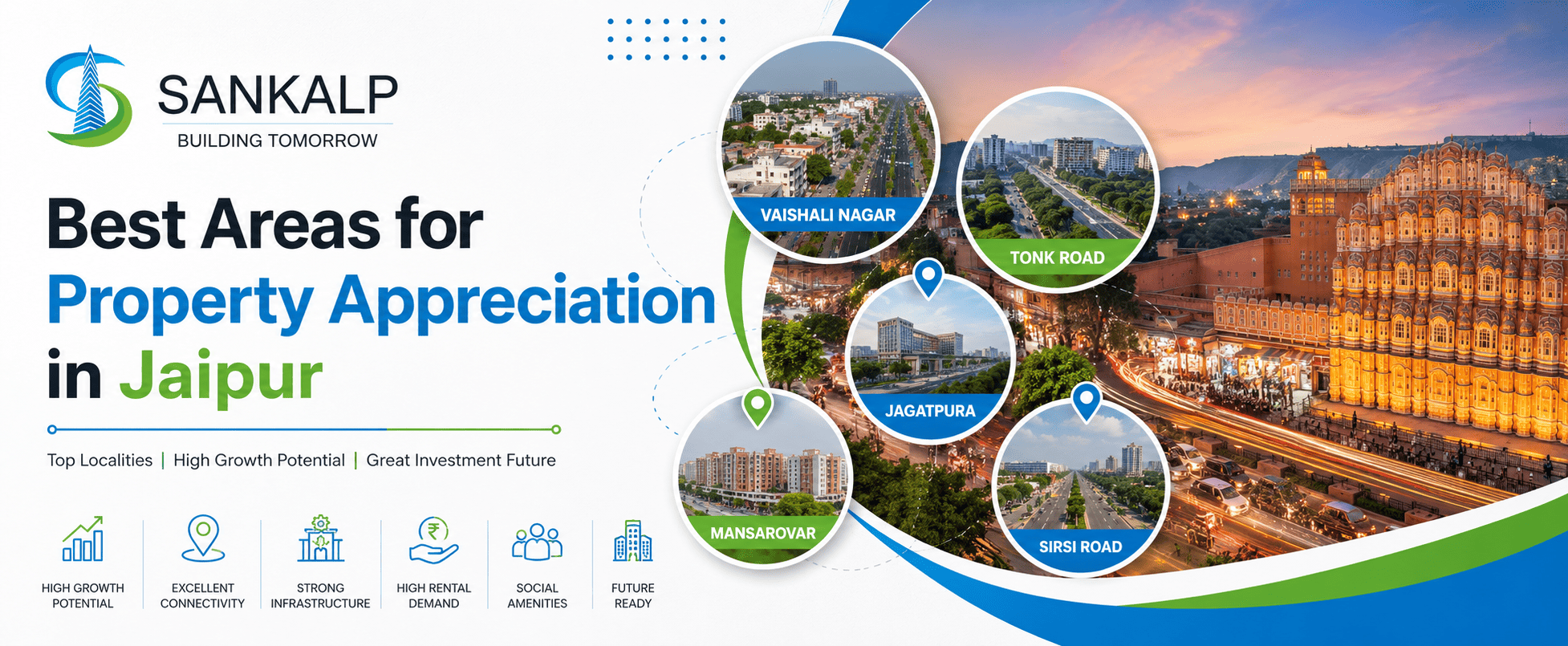
Property Appreciation is the quiet part of a real estate return, the gain in value that builds while you simply hold the asset. It rarely makes noise the way rental income does, but over years it usually decides whether a purchase was smart or ordinary. In Jaipur, appreciation is not spread evenly across the city; it concentrates in a few corridors for reasons you can actually verify. This guide explains how appreciation works here, how to read the rate honestly, and where it is most likely to happen.
What drives property appreciation
Appreciation in real estate is not luck. It follows a handful of forces that push demand up against limited supply.
- Infrastructure that shortens commutes, such as a metro line or a new road
- Employment nearby, which brings people who need homes
- Scarcity, since land near established areas cannot expand
- Rising government valuations, seen in the annual DLC rate revision
When several of these line up in one pocket, values tend to climb. When none do, a low price usually stays low for a reason.
How to read the appreciation rate honestly
The real estate appreciation rate you see quoted on listing sites is often a marketing figure, not a measured one. Treat it with care.
- Broker estimates are not official data, so verify before you rely on them
- For an official view, check the NHB RESIDEX housing price index
- Compare the DLC rate over time, since the government revises it each April 1
- Judge annual property appreciation over years, not months, because real estate moves slowly
A flat appreciation rate that sounds spectacular over one year often flattens when you look across five.
The corridors where appreciation concentrates
Property in Jaipur appreciates fastest where funded infrastructure is arriving, not where it is merely announced.
- Tonk Road, on the Metro Phase 2 priority stretch now entering construction
- Jagatpura, with its education and IT base and metro corridor access
- Sirsi Road, beside the established Vaishali Nagar belt, with a new JDA arterial road under way
- Sitapura and the southern belt, served by the operational Ring Road arc
Property value appreciation in these areas rests on public works you can confirm, which makes them steadier bets than corridors riding on a rumour.
The example that shows the pattern
Ajmer Road is a useful case study. Land near Bhankrota and Sanganer has reportedly risen around three and a half times over the past decade, helped by NH-48, the Ring Road and Mahindra World City. Read the timeframe carefully: a decade, not a year. That is the horizon appreciation genuinely works on, and it is why the buyers who do best are the ones who can hold.
Ready to move versus under construction
Timing shapes your appreciation too.
- Ready to move flats in Jaipur cost more but let you inspect the actual unit and start earning or living immediately
- Under-construction units often price lower, and buying early in a growing corridor can capture more of the rise, provided the builder delivers
The gain from buying early only materialises if the project completes, which is why the developer matters as much as the location.
Why the builder affects appreciation
A well-built, well-maintained project holds and grows its value better than a neglected one in the same area. Among the top builders in Jaipur, those with completed projects you can inspect years later give you a clearer read on how their buildings age. Flats in Jaipur that still function well in year eight command better resale than a tired building next door, whatever the area average says.
What about commercial
Commercial real estate appreciation rates behave differently from residential. Commercial value depends heavily on the sitting tenant and lease, so a well-tenanted unit in a business corridor can appreciate strongly, while a vacant one lags. If you are weighing commercial, judge it on lease strength and location, not on residential comparisons.
How to act on this
- Buy where infrastructure is funded and under construction, not announced
- Verify the project on the Rajasthan RERA portal before you pay
- Check the DLC rate for the exact colony on e-Panjiyan, since it sets your stamp duty and signals official value
- Plan to hold for five to ten years, the horizon appreciation actually needs
FAQs
- Which areas in Jaipur have the best property appreciation?
Corridors tied to funded infrastructure tend to lead, including Tonk Road on the metro stretch, Jagatpura, and Sirsi Road beside Vaishali Nagar. Verify each project before buying.
- How is the property appreciation rate calculated?
It compares a property's value over time. For an official view, use the NHB RESIDEX index and track DLC rate revisions, rather than relying on broker estimates.
- How long should I hold a property for good appreciation?
Usually five to ten years. Real estate moves slowly, and the clearest gains, such as Ajmer Road's reported rise, played out over a decade.
- Do ready to move flats appreciate as well as under-construction ones?
Both can appreciate. Under-construction units in a growing corridor may capture more of the rise if the builder delivers, while ready flats let you inspect and use the property at once.

Anil Shah
The Anil Shah editorial team writes about Jaipur real estate - market trends, home-buying guides, RERA updates and investment insights - drawing on 25+ years of building landmark residential and commercial projects across the city.
Looking for your dream property in Jaipur?
Explore RERA-certified homes & commercial spaces by Sankalp Group. Book a free site visit today.