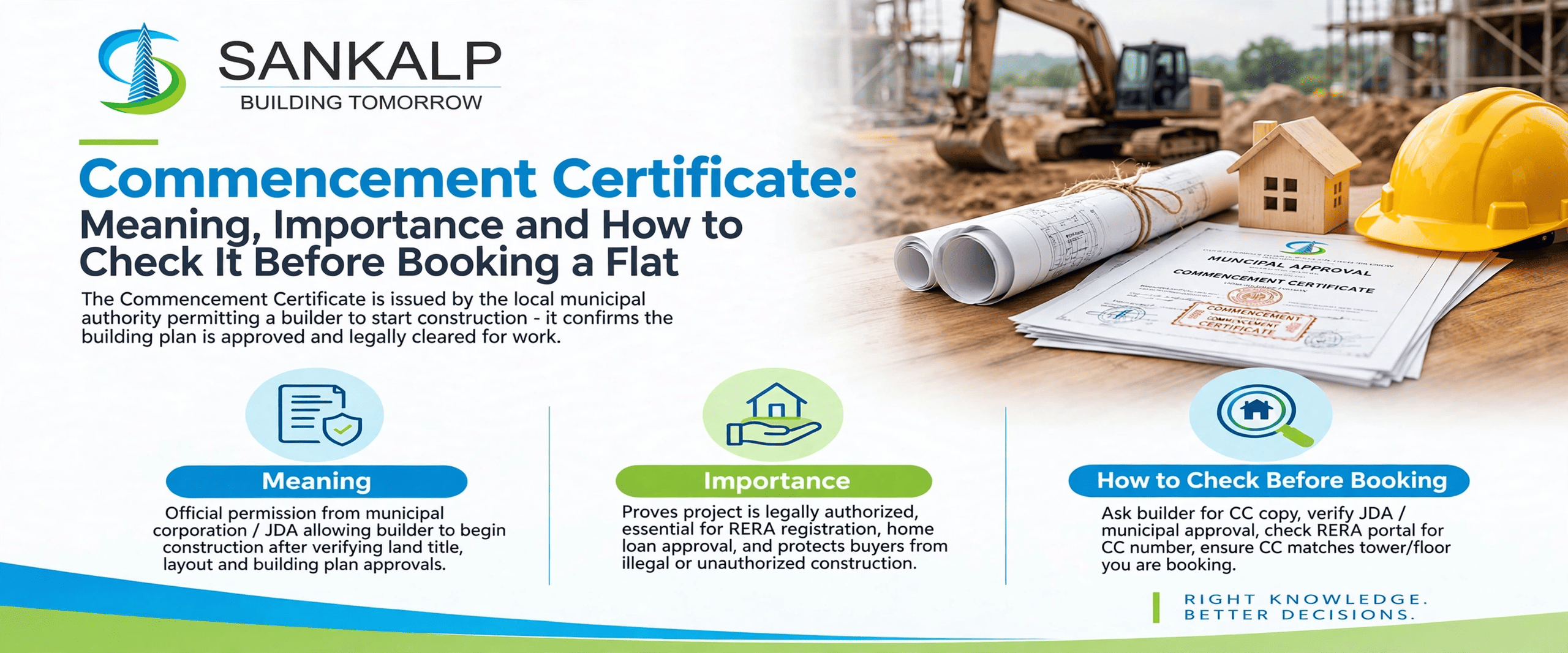
Commencement Certificate: Meaning, Importance and How to Check It Before Booking a Flat
Most people booking a flat spend their time on the things they can see: the sample flat, the view, the parking, the price per square foot. The documents that decide whether the building should exist at all get a quick glance, if that. Yet the approvals are what separate a safe purchase from a long legal problem. A builder needs permission before the first column is poured, and the paper that records that permission is the Commencement Certificate.
This guide explains what a Commencement Certificate is, who issues it, how it differs from the other approvals you will hear about, and how to check it before you pay a booking amount for flats in Jaipur or anywhere else in India. The names of these documents and the offices that issue them change from state to state, so the article also explains how the system works in Jaipur and Rajasthan specifically, and where general practice differs from local rules.
Why approvals matter more than the brochure
A brochure is a promise. An approval is a fact. When a builder markets 3 BHK flats in Jaipur with a club, a pool and twelve floors, the only way to know that twelve floors are allowed on that plot is to read the approved building plan and the permission that lets construction begin. If the permission covers eight floors and the brochure shows twelve, the extra four are a risk the buyer carries, not the builder.
Checking approvals early also protects the money. Once a booking amount is paid, every later step, from the agreement to the home loan to the registration, assumes the project is legal. Finding out otherwise at the loan stage means a refund fight; finding out at the possession stage can mean a flat that cannot get an occupancy certificate, a water connection or a property tax record in your name.
What is a Commencement Certificate?
A Commencement Certificate is the document from the local planning or municipal authority that allows a builder to start construction on a plot. It is issued after the authority has approved the building plan and is satisfied that the plot, the layout and the proposed building meet the local building rules. In plain words, the approved plan says what can be built; the Commencement Certificate says building may now begin.
In many cities the certificate is issued in two stages. The first allows work up to the plinth, which is the base of the building at ground level. The authority then inspects the plinth to confirm it matches the approved plan, and only then issues the second stage, which allows the superstructure, meaning the floors above. A buyer looking at a project where only the plinth stage has been cleared should know that the floors above are not yet formally permitted.
How it works in Jaipur and Rajasthan
Rajasthan does not always use the words Commencement Certificate the way Maharashtra or Karnataka do. In Jaipur, the key approval is the building permission, often called the sanctioned map or approved building plan, issued by the Jaipur Development Authority for areas under its control or by the Nagar Nigam for areas under the municipal corporation. Housing Board colonies and private township schemes have their own route to the same approval. The Jaipur Building Bye-Laws 2020 require construction to begin within three years of the plan approval date and require the approved map and a notice board with the approval details to be kept at the site.
For a buyer this means two things. First, ask for the building permission and approved plan from the authority, and treat that as the Jaipur equivalent of a Commencement Certificate. Second, check the project on the RERA site for Rajasthan, because RERA registration requires the promoter to attach the commencement certificate or equivalent sanction along with the other approvals when the project is registered. The same logic applies whether you are looking at apartments in Jaipur, a plotted scheme or commercial property in Jaipur.
Why a Commencement Certificate is important
| What it does | Why it matters to the buyer |
|---|---|
| Confirms the authority has approved the plan and allowed construction to start | The building is legal from the first day, not regularised later |
| Fixes the number of floors, the built-up area and the use (residential, commercial, mixed) | What is marketed should match what is permitted |
| Is a condition for RERA registration under Section 4(2)(c) of the RERA Act | A project cannot be legally advertised or sold without RERA registration, and RERA registration needs this approval |
| Is checked by banks before sanctioning a home loan on the project | A project without it is usually not bank-approved, which limits your loan and your resale |
| Leads on to the Completion Certificate and the Occupancy Certificate | Without a lawful start, the authority may refuse the certificates needed to occupy the flat and get utilities |
Who issues the Commencement Certificate?
The issuing body is always the local planning or municipal authority, but the name differs by city. The table below shows the general picture and the position in Jaipur.
| Area | Issuing authority | Document usually called |
|---|---|---|
| Mumbai and most of Maharashtra | Municipal corporation or MHADA / MMRDA where applicable | Commencement Certificate (CC) |
| Bengaluru | BBMP or BDA | Commencement Certificate |
| Delhi | MCD / DDA | Building sanction and commencement notice |
| Jaipur, JDA area | Jaipur Development Authority | Building permission / sanctioned map |
| Jaipur, municipal area | Nagar Nigam Jaipur (Heritage and Greater) | Building permission / sanctioned map |
| Other Rajasthan cities | Urban Improvement Trust or Nagar Palika / Nagar Nigam | Building permission |
The department inside the authority is usually the town planning or building permission wing, which checks the plan, the land use, the set-backs, the height and the fire and environmental clearances before giving the go-ahead.
How to check and verify a Commencement Certificate before booking
Verification takes an hour and costs nothing. Follow the steps in order.
Step 1: ask the builder for a copy
Ask the sales office for a copy of the Commencement Certificate or, in Jaipur, the building permission and sanctioned map. A builder with the approval in hand will share it the same day. Reluctance, a promise that it is "in process", or an offer to show it only after booking are all reasons to pause.
Step 2: read the details on the certificate
| Detail to check | What to compare it with |
|---|---|
| Plot or khasra number and scheme name | The title deed and the RERA registration page |
| Name of the owner or developer | The company named in the brochure and the agreement for sale |
| Date of issue and validity or start-by date | In Jaipur, construction must start within three years of plan approval; check that it has not lapsed |
| Number of floors and total built-up area permitted | The brochure, the floor you are buying and the tower height on site |
| Permitted use | Residential for flats in Jaipur; commercial or mixed for commercial property in Jaipur |
| Stage covered (plinth only or full superstructure) | Whether your floor is within the cleared stage |
| Conditions attached (fire NOC, environmental clearance, parking, set-backs) | Whether the builder has obtained the conditional NOCs |
| Signature, seal and file or reference number | Needed for the authority check in step 3 |
Step 3: verify with the authority
Take the reference number to the issuing office or its online portal. The Jaipur Development Authority and the Nagar Nigam both run online building permission systems where approved plans can be looked up by file number or applicant name. If the portal does not show the record, an application under the Right to Information Act to the building permission wing will produce a copy of the sanction and its conditions. Ask for the sanctioned plan drawing as well as the permission letter, since the drawing shows the floors and set-backs the letter only refers to.
Step 4: cross-check on the RERA site
Open the project page on the RERA site for Rajasthan. The promoter's uploads should include the building permission, the layout approval and the land title documents, and the project details should state the number of floors and units that match the certificate. A mismatch between the RERA page and the certificate is a question the builder must answer in writing before you proceed.
Step 5: walk the site
Count the floors being built and compare them with the permitted number. Look for the notice board with the approval details that the Jaipur bye-laws require at the site. Check that the plinth and set-backs on the ground roughly match the plan. A buyer does not need an engineer for this; an obvious extra floor or a tower standing where the plan shows a park is visible to anyone.
Step 6: get a lawyer's opinion for a large purchase
For 4 BHK flats in Jaipur or 5 BHK flats in Jaipur, where the price runs into crores, a property lawyer's written opinion on the title and approvals is a small cost against the sum involved. The lawyer will also check whether the land use allows the project, whether any conversion was needed, and whether the approvals cover the phase you are buying in.
Commencement Certificate vs the other approvals
Buyers hear five names and often treat them as one. They are five different documents, issued at different times, by different bodies, for different reasons.
| Document | Issued by | When | What it proves | What it does not prove |
|---|---|---|---|---|
| Approved building plan (sanctioned map) | Planning or municipal authority | Before construction | The design, floors, area and use the authority has accepted | That construction has been allowed to start |
| Commencement Certificate / building permission | Same authority | After plan approval, before work starts | Construction may legally begin, up to the stage stated | That the building was finished as per plan |
| RERA registration | State Real Estate Regulatory Authority | Before the project is advertised or sold | The promoter has filed approvals, title, timelines and bank details and is bound by RERA | That the authority has independently verified every approval; RERA relies on what the promoter files |
| Completion Certificate | Planning or municipal authority | After construction | The building was built according to the approved plan and bye-laws | That the building is fit and permitted for living |
| Occupancy Certificate | Same authority | After completion and inspection | The building may be occupied; utilities and property tax records can be opened in owners' names | Nothing about the land title |
How they fit together
Think of the documents as a chain. The approved plan comes first. The Commencement Certificate lets the builder act on that plan. RERA registration lets the builder sell what the plan and the certificate allow. The Completion Certificate confirms the builder did what the plan said. The Occupancy Certificate lets the buyer move in. A break anywhere in the chain shows up later as a flat that cannot be registered cleanly, cannot get an occupancy certificate, or sits in a building the authority treats as unauthorised.
None of these documents replaces the title check. A perfectly approved building on disputed land is still a bad purchase, so the title deed, the land conversion record and the encumbrance certificate are checked alongside the approvals, not instead of them.
A note on the DLC rate
The DLC rate is the government's minimum value for stamp duty in a locality and has nothing to do with approvals. Buyers sometimes assume a flat registered at the DLC rate must be legal; registration of a sale deed does not confirm that the building was approved. The sub-registrar records the transfer; the planning authority decides whether the building is lawful.
Risks of booking without the required approvals
The absence of a single paper does not automatically make a project illegal; a builder may hold a valid building permission under a different name, or the stage-two certificate may be days away. But proceeding without confirming the approvals shifts every one of the following risks onto the buyer.
| Risk | How it shows up |
|---|---|
| Construction stopped by the authority | Work halts, possession slips by years, and the builder blames the authority |
| Extra floors demolished or regularised at a cost | If your flat is on an unapproved floor, it may be the one removed, or you pay a regularisation fee |
| No Completion or Occupancy Certificate | No permanent water or electricity connection, no property tax record in your name, and a building the authority treats as unauthorised |
| Home loan refused or recalled | Banks lend only against approved projects; a later discovery can trigger a demand for repayment |
| RERA registration cancelled or refused | The builder loses the right to sell; buyers are left negotiating refunds |
| Poor resale | The next buyer's lawyer will find the gap, and the flat sells at a discount or not at all |
Documents to check before booking a flat
The Commencement Certificate is one item on a short list. Use this checklist before paying a booking amount for any flats in Jaipur or apartments in Jaipur, new or under construction.
Land and title
- Title deed of the plot in the builder's or landowner's name, with the chain of earlier deeds
- Development agreement, if the landowner and the builder are different
- Land conversion order (for example under Section 90A or 90B in Rajasthan) where the land was agricultural
- Encumbrance certificate for the plot for at least the past thirteen years
- Bank no-objection if the plot is mortgaged for project finance
Approvals
- Approved building plan or sanctioned map from the Jaipur Development Authority or Nagar Nigam
- Commencement Certificate or building permission, with the stage it covers
- Fire NOC, environmental clearance (for larger projects), airport height NOC where applicable
- Layout approval for the scheme, if the flat is in a township
RERA
- RERA registration number and the project page on the RERA site, with the approvals uploaded
- Promised completion date and the quarterly progress updates
- The form of agreement for sale filed with RERA
For a finished building
- Completion Certificate
- Occupancy Certificate, before possession is taken
- Property tax assessment for the building, showing it is on the municipal record
Money
- Full cost sheet with every charge, including parking, club, maintenance deposit and GST
- Payment schedule linked to construction stages, not to dates
- Stamp duty and registration estimate on the higher of the price and the DLC rate
A buyer who ticks these boxes has done more due diligence than most, and has done it before any money changed hands, which is the only time it is cheap.
Conclusion
Before paying a booking amount, confirm four things: that the land title is clean, that the building plan is approved, that a Commencement Certificate or building permission allows construction of the floor you are buying, and that the project is registered on the RERA site with the same details. For a finished building, add the Completion Certificate and the Occupancy Certificate. Check each document against the official record, not against the builder's copy alone, and for a large purchase let a qualified property lawyer read the file before you sign. The Commencement Certificate is a small document, but it is the one that tells you the building had the right to begin.
Frequently asked questions
What is a Commencement Certificate in real estate?
It is the approval from the local planning or municipal authority that allows a builder to start construction after the building plan has been sanctioned. In Jaipur it is usually issued as the building permission along with the sanctioned map.
Is a Commencement Certificate mandatory for every project?
Any building that needs plan approval needs permission to begin construction, and RERA requires the promoter to attach the commencement certificate or equivalent sanction at registration. The exact name and format vary by state and by authority, so check what the local rule in your city requires.
How can I check a Commencement Certificate online?
Look up the project on the state RERA site, where the approvals are uploaded, and search the building permission portal of the issuing authority, such as the Jaipur Development Authority or Nagar Nigam, by file number or applicant name. Where a portal does not show the record, an RTI application to the authority will.
Is a Commencement Certificate the same as RERA registration?
No. The Commencement Certificate is a construction approval from the planning authority. RERA registration is a separate registration of the project with the state regulator, and the Commencement Certificate is one of the documents the promoter must file to obtain it.
What documents should I check before booking a flat?
The title deed and encumbrance certificate for the land, the approved building plan, the Commencement Certificate or building permission, the RERA registration page, the fire and other NOCs, and for a completed building the Completion Certificate and Occupancy Certificate, along with the full cost sheet.

Anil Shah
The Anil Shah editorial team writes about Jaipur real estate - market trends, home-buying guides, RERA updates and investment insights - drawing on 25+ years of building landmark residential and commercial projects across the city.

Looking for your dream property in Jaipur?
Explore RERA-certified homes & commercial spaces by Sankalp Group. Book a free site visit today.