Occupancy Certificate Explained: Meaning, Importance and How to Get It in Jaipur
Buying a home is the biggest purchase most families ever make. But there is one paper that decides whether you can legally live in that home, and most buyers never ask for it. That paper is the occupancy certificate.
Think of it this way. A builder can finish a building. It can look complete. It can have paint, tiles, lifts and a garden. But until the government checks it and says "yes, people can live here", the building is not fully legal. The occupancy certificate is that green signal.
This guide explains the certificate in simple words. What it is, why it matters, how it is issued in Jaipur, and how you can check it yourself before you pay your money.
What is an Occupancy Certificate?
An occupancy certificate is a paper given by the local government office. In most parts of Jaipur, that office is the Jaipur Development Authority, which people call JDA. In some areas it is the Nagar Nigam or the Urban Improvement Trust.
The office sends an officer to look at the finished building. The officer checks three main things:
- Map check: the building must match the map that was approved before construction started, including floors, height, open space and parking.
- Safety check: the required approvals must be in hand, especially the final fire clearance for tall buildings.
- Service check: water, electricity, sewerage and drainage must be installed and actually working.
If the answer to all three is yes, the office gives the certificate.
Here is an easy way to remember the oc certificate meaning. A licence does not build your scooter. It only allows you to ride it on the road. In the same way, this certificate does not build your flat. It only allows the flat to be used as a home.
OC CC Full Form in Simple Words
You will hear two short forms again and again while buying property. Do not mix them up.
| Short form | Full form | What it says | When it comes |
|---|---|---|---|
| CC | Completion Certificate | The building is built as per the approved map | Right after construction ends |
| OC | Occupancy Certificate | The building is now fit and allowed for people to live in | After CC, after finishing work is done |
So the oc certificate full form is Occupancy Certificate. CC means Completion Certificate.
In the Jaipur building rules, Rule 16 talks about the completion certificate. Rule 17 talks about the building occupation certificate. One comes after the other. They are not the same thing.
If a builder shows you a CC and calls it an OC, either he has made a mistake, or he is hoping you will not notice. Ask again.
Key Things to Know About an Occupancy Certificate
- It is given for the whole building or tower, not for one single flat. Everyone in that tower depends on the same paper.
- It never expires. Once the building gets it, it stays valid as long as the building stands. It can only be taken back if a serious rule is broken later.
- It is given only after a real visit. An officer or a government-registered architect comes to the site and checks.
- It depends on the approved map. One extra floor, or a car park turned into shops, and the file gets stuck.
- It stays in the government record forever. You can use it later when you sell, take a loan, or fight a case.
Why an Occupancy Certificate is Important
Ask any honest real estate developer in Jaipur and they will tell you this one paper quietly controls many things in daily life.
You can live there legally. Moving into a building with no certificate means you are staying there without permission. The office can send a notice, charge a penalty, or in bad cases even seal the wrong portion.
You get proper water and power. Permanent electricity and water connections are usually given only after the building is legally complete. Some families in Jaipur have been stuck on temporary connections for years, paying higher rates for the same electricity.
Your home loan gets released. Banks keep this paper on their final checklist. Their lawyers and engineers look for it before giving the last payment.
You can sell easily later. When you sell, the next buyer's lawyer will ask for it. A property in Jaipur without this certificate gets fewer buyers and lower prices.
Your society can be formed. Common areas like the lift, lobby, park and terrace are handed over to the flat owners' group only when the building is properly complete.
You can claim tax benefit. Income tax benefit on home loan interest starts from the year you get possession. This certificate is the cleanest proof of that date.
Benefits Of Occupancy Certificate
| Benefit | What it means for you |
|---|---|
| Legal safety | Nobody can call your stay unauthorised |
| Proper connections | Permanent water, power and sewer lines |
| Loan support | Final loan amount released without trouble |
| Easy resale | Fewer objections from the next buyer |
| Insurance | Insurance companies trust a checked building |
| Tax benefit | Proof of your possession date |
| Peace of mind | Fire, structure and services already checked |
The Process of Obtaining an Occupancy Certificate in Jaipur
The steps in Rajasthan follow a fixed order. If you know the order, you can ask the builder better questions.
Step 1. Build as per the approved map. The tower must follow the sanctioned plan, the open space rules, the height limit and the parking plan.
Step 2. Take the completion certificate. When construction ends, the builder applies for the CC. Here the office checks whether the building on the ground matches the building on paper.
Step 3. Finish everything inside. After the CC, the builder must complete the work that makes the building usable. This includes electric work, water supply, the sewage treatment plant, the transformer, painting, false ceiling, site development, parking signs, landscaping and plants.
Step 4. Get the fire clearance. For all tall buildings and special buildings, the final no-objection letter from the fire officer must be ready first. Without it the certificate cannot be given.
Step 5. Get environment clearance if needed. Some projects need environment approval. In those cases the approval must be given before the certificate. Also, Consent to Operate must be taken from the environment department within three months after the certificate is issued.
Step 6. Apply and get inspected. The builder applies to the competent officer or to a government-registered architect. Under the Jaipur rules, the certificate should be issued within seven days of the application, after the site check.
Step 7. Certificate is issued. The paper is granted, entered into the office record, and shared with the flat buyers.
In real life, delays happen. The most common reasons are unfinished work inside, a pending fire NOC, or some change made from the approved map that must be fixed first. That last one causes the longest delays. Ask the builder directly if any such correction file is pending.
Documents Required for Obtaining an Occupancy Certificate
The list of occupancy certificate documents required changes a little from project to project, but the main papers are almost always the same:
- Copy of the approved building map and building permission letter
- The completion certificate of the project
- Land papers such as patta, lease deed or allotment letter
- Site plan and drawings of the building as actually built
- Structural safety certificate from the structural engineer
- Certificate from the architect saying the work matches the approved map
- Final fire no-objection certificate for tall and special buildings
- Environment and pollution board approvals, where they apply
- Proof of rainwater harvesting and sewage treatment system
- Photographs of the finished building from front and back
- Receipts of development charges and other government fees
- Affidavits from the owner or the builder
Builders who keep this file ready from day one get their certificate in weeks. Builders who do not can spend a year running behind signatures.
Partial and Full Occupancy Certificate
Big projects are built in phases. Tower A may be ready while Tower C is still coming up. This is where the partial certificate is used.
| Point | Partial Certificate | Full Certificate |
|---|---|---|
| Covers | Only the towers or floors that are ready | The whole project |
| Given when | Other parts are still under construction | Everything is finished |
| Common areas | Some may still be incomplete | All ready and handed over |
| Your position | You can legally live in your flat | Everything is closed and clear |
| Difficulty | Noise, dust and limited facilities around you | Almost none |
A partial certificate is completely legal and often useful. The problem starts when a buyer thinks it is the final one.
If you are buying in a phased project, ask one clear question: which towers does this certificate cover? Then ask when the full certificate is expected, and get that date in writing.
The Legal Side of an Occupancy Certificate
Since 2016, this is not just good practice. It is the law.
The Real Estate (Regulation and Development) Act, 2016 says:
- Section 11(4)(b): The builder must obtain the completion certificate or the occupancy certificate, or both where needed, and give it to the buyers.
- Section 17(1): The builder must hand over the flat only after getting the occupancy certificate, and must hand over the common areas to the owners' association.
- Section 19(10): The buyer should take possession within two months from the date the certificate is issued.
Rajasthan follows these through the Rajasthan Real Estate (Regulation and Development) Rules, 2017. Every registered project is listed on the RERA site of the Rajasthan Real Estate Regulatory Authority. Anyone with a phone and internet can check a project there.
In simple words: if a builder hands over your flat without this certificate, he has broken the law, and you have a place to complain.
Common Problems and Disputes
Most fights over this certificate look the same.
Possession given without the certificate. The builder asks for the last payment and gives you the keys, but the certificate is still pending. You can refuse to take formal possession and complain to the authority.
Change from the approved map. An extra floor, less open space, or a common area sold off as shops. The office holds back the certificate until the change is removed or regularised. The buyers get stuck in between.
Government dues not paid. Unpaid development charges can stop the file even when the building itself is fine.
Certificate taken back. If a serious violation is found later, the certificate can be cancelled. Then the legal position of the whole building becomes shaky.
Higher property tax. In several Indian cities, buildings occupied without a valid certificate have been charged much higher property tax. So this paper protects your pocket too.
The safest step for a buyer is simple. Write one line in your agreement: the last instalment will be paid only after the occupancy certificate is produced. Builders with clean approvals rarely say no to this.
How to Verify an Occupancy Certificate
If you are looking at flats in Jaipur, check the paper yourself. Do not accept a photocopy without asking questions.
- Read it properly. Look at the name of the office, the certificate number, the date, the project name, and which towers are covered.
- Compare with the map. Check the number of floors, the built-up area and the number of flats against the approved plan.
- Confirm at the office. Go to the JDA zone office or municipal office with the certificate number and ask them to confirm from their record.
- Check the RERA registration. Search the project on the state authority website and read the uploaded papers.
- Ask your lawyer or bank. Their team will catch anything that does not match.
- Talk to residents. In a partly occupied project, people living there will tell you the truth in two minutes.
How to Check Occupancy Certificate Online
Online checking has become much easier in Rajasthan. The occupancy certificate online route works like this:
- Open the JDA citizen services portal. Completion certificate and occupancy certificate services are both listed there.
- Use the file number or application number given by the builder to see the status.
- The Urban Development and Housing Department website also has a certificate verification section along with the procedure and checklists.
- Check the project on the Rajasthan RERA portal for registration status and the builder's filings.
One simple rule. If a builder cannot give you a number you can trace online, that silence is itself an answer.
Common Wrong Ideas About Occupancy Certificates
"The completion certificate is enough." It is not. CC says the building is built correctly. OC says you may live in it. You need both.
"People already live there, so it must be fine." Sadly, no. Many buildings are occupied without the certificate. Neighbours are not proof.
"Registry of the flat covers everything." Registry only transfers ownership. It involves stamp duty in Rajasthan, which is 6 per cent for men and joint buyers and 5 per cent for a woman buying alone, plus a labour cess of 20 per cent on the duty, plus 1 per cent registration fee. All of it is calculated on the higher of the sale value or the DLC rates. None of this says anything about whether the building is safe to live in. These are two different systems.
"Only tall towers need it." Wrong. Smaller homes and shops come under the building rules too.
"It has to be renewed." No. The certificate has no expiry. What does have a validity period is the building permission and the RERA registration.
"Ready to move means fully approved." Not always. When you look at ready to move flats in Jaipur, ask for the certificate number in your first visit, not the last one.
Simple Checklist Before You Buy
| What to check | Where to check | Warning sign |
|---|---|---|
| Approved building map | Builder's file, JDA record | Map does not match the building |
| Completion certificate | Builder, government office | Only verbal promise given |
| Occupancy certificate | Government office, online portal | No certificate number shared |
| Is your tower covered | Text written on the certificate | Your block is left out |
| Fire NOC | Builder, fire department | A temporary NOC shown as final |
| RERA registration | Rajasthan RERA website | Registration expired or missing |
| Land papers | Patta, lease deed, past sale deeds | Gaps in the ownership chain |
Conclusion
An occupancy certificate is not a small formality that comes at the end. It is the final proof that everything promised on paper really exists on the ground, safely and legally.
If you are looking at apartments in Jaipur, this is the fastest way to separate a good project from a risky one. A project that has this certificate has already passed checks on structure, fire safety, services and map compliance. That is a lot of homework already done for you.
Good developers in the city treat this paper as part of the delivery, not as an afterthought. So ask early. Ask for a number you can check. Put the answer in writing. A few questions today can save years of trouble later, and asking costs you nothing.
Frequently Asked Questions
-
What is meant by Occupancy Certificate?
It is a paper given by the local development or municipal office. It says the finished building matches the approved map, has the required clearances, and is fit for people to live in. It is given after construction is over and after an officer checks the site. -
Who gives the OC certificate?
The local government office. In Jaipur this is usually the Jaipur Development Authority, or the municipal corporation, or the Urban Improvement Trust, depending on the area. Under the Rajasthan rules, the application goes to the competent officer or to a government-registered architect, who inspects the building and then issues the certificate. -
Is OC mandatory in Rajasthan?
Yes. The Jaipur and Rajasthan building rules require it after the completion certificate. The Real Estate (Regulation and Development) Act, 2016 along with the Rajasthan Rules, 2017 makes it the builder's duty to get it and give it to buyers before handing over the flat. -
Can we get OC without CC?
No. The order is fixed. First the completion certificate confirms the building matches the approved map. Then, after the finishing work, services and the final fire NOC are done, the occupancy certificate can be applied for. -
How long is an OC certificate valid?
There is no expiry date. It stays valid for the life of the building. It can only be cancelled if the office finds a serious violation or an illegal change made later. Building permission and RERA registration have validity periods, but this certificate does not. -
What is OC and CC in property?
CC is the Completion Certificate. It says the building was constructed as per the approved plan. OC is the Occupancy Certificate. It allows the finished building to be lived in. CC answers whether it was built right, and OC answers whether it can be lived in now. A buyer should see both papers.

Anil Shah
The Anil Shah editorial team writes about Jaipur real estate - market trends, home-buying guides, RERA updates and investment insights - drawing on 25+ years of building landmark residential and commercial projects across the city.
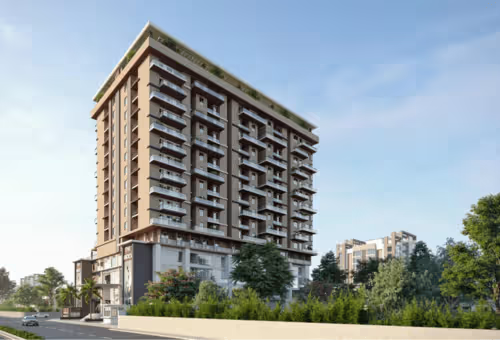
Looking for your dream property in Jaipur?
Explore RERA-certified homes & commercial spaces by Sankalp Group. Book a free site visit today.