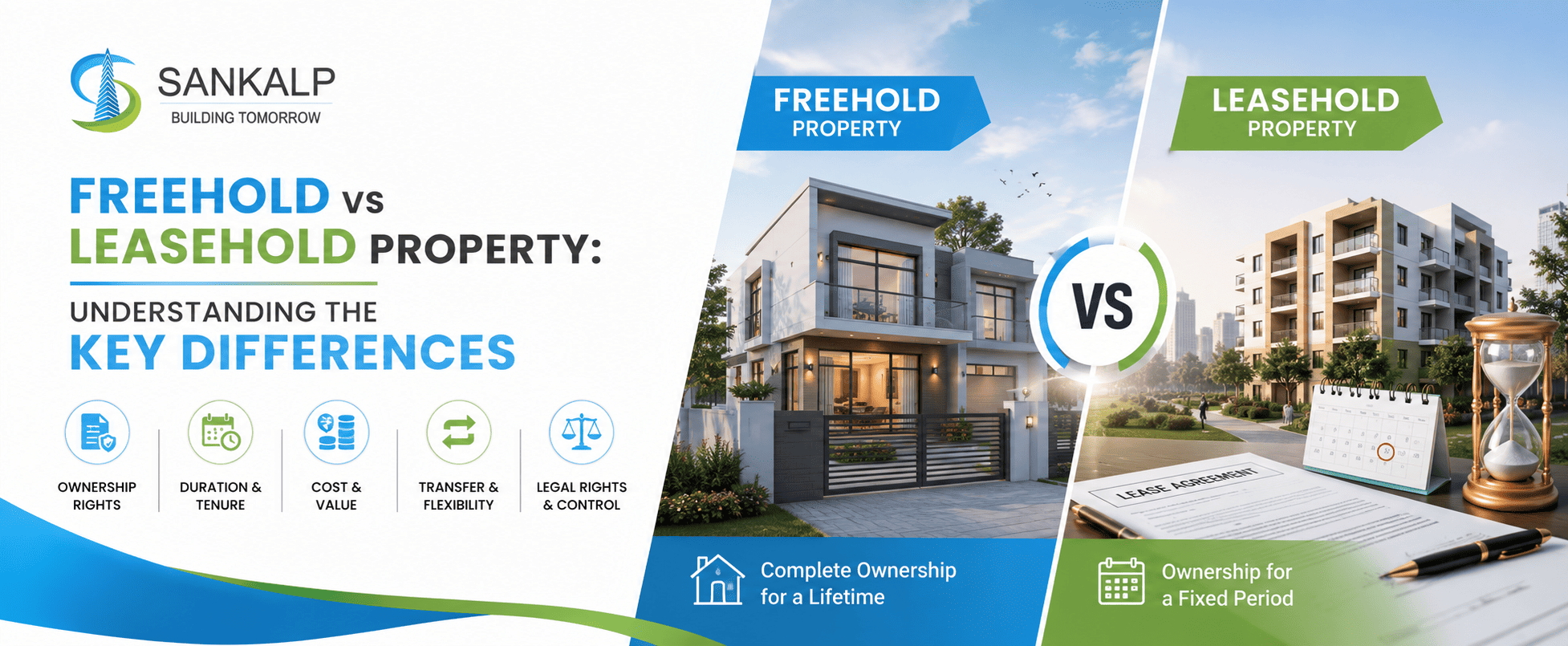
Two flats can sit in the same building, look exactly the same and cost the same money, yet give you very different rights. The reason is the type of ownership. Understanding freehold vs leasehold property matters because it decides one simple thing: do you own your home forever, or do you hold it for a fixed number of years on land that belongs to somebody else?
Most buyers never ask this question. They ask about the price, the floor, the amenities and the possession date, and only discover the ownership type when the paperwork is being prepared. By then, the price has already been agreed. This guide explains both types fully, in plain language, so you know what you are buying before you start negotiating.
Freehold Means in Property: What You Actually Own
Freehold is the simplest form of ownership. You own the building and the land underneath it, completely and permanently.
Think of it like this. If you buy a freehold flat, nobody sits above you in the ownership chain. There is no landlord, no lease, no expiry date and no permission needed from anyone when you want to sell.
Here is what freehold gives you:
- Ownership with no time limit. The property stays yours for as long as you want it, and passes to your children after you.
- Freedom to sell or gift. You do not need anyone's approval to transfer the property.
- Freedom to mortgage. Banks lend easily against freehold property, because there is no expiry risk.
- No ground rent. You pay property tax to the municipality, but no rent to a landowner.
- Your name in the records. The title is recorded in your name in the government's land records.
To define freehold property in one line: it is complete and permanent ownership. This is what most buyers assume they are getting, and in most cases it is what they should insist on.
Leasehold Meaning: Ownership With a Clock Running
A leasehold property is one you hold for a fixed number of years under a lease. The land still belongs to somebody else, called the lessor. In India, the lessor is very often a government body such as a development authority or a housing board.
Imagine renting a shop for 99 years instead of eleven months. You control it, you can usually sell your remaining interest in it, you can pass it to your family, but the land itself never became yours. That is roughly what leasehold means, though the periods involved are long enough that people forget the lease exists.
What leasehold involves:
- A fixed term. Common lease periods are 30, 60, 90 or 99 years from the date the lease started.
- Land stays with the lessor. You own the building rights, not the land.
- Lease rent may apply. Some leases require an annual ground rent, which can be small but must be paid.
- Permission to transfer. Selling usually needs the lessor's approval, often in the form of a no objection certificate, and sometimes a transfer fee.
- Conditions of use. The lease deed may specify what the land can be used for, and breaking that condition can put the lease at risk.
- Renewal at the end. When the term expires, the lease must be renewed. Renewal is not automatic and may cost money.
Leasehold is not a bad thing in itself. A very large amount of urban land in India, including in Jaipur, started as leasehold. It simply comes with conditions, and those conditions should be reflected in the price you pay.
Why the Remaining Years Matter So Much
This is the single most important thing to understand about leasehold, and it is where buyers lose money.
A 99-year lease sounds endless. But if the lease started in 1970, then by 2026 fifty-six years have already gone, and only forty-three remain. If it started in 1955, only twenty-eight years are left. The lease term runs from when it was granted, not from when you buy.
Why this matters in practice:
- Banks look at the remaining term. Most lenders want a comfortable number of years left, usually well beyond the loan tenure. If very few years remain, they may reduce the loan amount or refuse it entirely.
- Your future buyer faces the same problem. If you buy with forty years left and sell after ten, your buyer has thirty. Their bank may hesitate, which limits who can buy from you.
- Value falls as the clock runs down. A leasehold property with a short remaining term is worth noticeably less than the same property with a long one.
So when you look at any leasehold property, the first question is not the price. It is: when did the lease start, and how many years are left?
Types of Leasehold You Will Come Across
Leasehold types differ mainly by who granted the lease and for what purpose.
Development authority leases. Land allotted by a body such as the Jaipur Development Authority for residential or commercial use, commonly on a long lease.
Housing board allotments. Plots and flats allotted by state housing boards, frequently granted on lease rather than sold outright.
Institutional and industrial leases. Land given for a declared purpose such as a school, hospital or factory. These carry the strictest use conditions, and the land cannot simply be used for something else.
Private long leases. An arrangement between two private parties, less common for homes but seen in some commercial properties.
In Jaipur, a considerable amount of land allotted historically by the development authority and the housing board was granted on lease rather than sold. That is why the freehold question comes up so often here, particularly in older colonies.
The Key Differences, Side by Side
Here is how the two compare on the things that actually affect you.
Length of ownership. Freehold continues indefinitely. Leasehold ends on a fixed date unless renewed.
Selling the property. Freehold needs nobody's permission. Leasehold usually needs the lessor's consent, and often a transfer fee is payable.
Getting a home loan. Banks lend comfortably against freehold. For leasehold, funding depends on how many years remain, and a short term can block the loan.
Resale value. Freehold generally fetches more, because the buyer inherits no conditions. Leasehold with a short term is harder to sell and fetches less.
Regular costs. Leasehold may involve ground rent and eventual renewal charges. Freehold involves neither.
Freedom of use. Leasehold deeds often restrict how the property may be used. Freehold gives you far more latitude, subject only to municipal rules.
Inheritance. Both can pass to your heirs, but with leasehold, what passes is the remaining lease term, not the land.
Anyone comparing flats in Jaipur should establish the ownership type before discussing price, because the answer changes what that price is actually buying.
Converting Leasehold to Freehold
This is the question most owners of leasehold property eventually ask, and the good news is that conversion is often possible.
In many Indian cities, including Jaipur, leasehold plots allotted by government bodies can be converted to freehold by paying a conversion charge and completing the prescribed process. Once converted, the property becomes permanently yours and the lease conditions fall away.
The general process works like this:
- Apply to the authority that granted the lease, such as the development authority or housing board, using their prescribed application.
- Clear all outstanding dues, including any unpaid lease rent, since arrears must be settled before conversion.
- Submit the required documents, typically the original lease deed, allotment letter, identity proof and proof of payments.
- Pay the conversion charges as fixed by the authority, which vary by location, plot size and the year of allotment.
- Receive the conversion deed or freehold patta, and get it registered at the sub-registrar office so the change is legally recorded.
Two cautions here. First, charges and eligibility rules change from time to time, so confirm the current position directly with the Jaipur Development Authority rather than relying on what a seller or broker tells you. Second, if a seller says conversion is "just a formality," treat that as a claim you must verify, not a fact. Sometimes there are pending dues, an unclear title or a use violation that makes conversion difficult, and the seller may be leaving that discovery to you.
If a property is being sold as "conversion pending," a safer approach is to make the conversion the seller's responsibility before the sale completes, or to reduce the price to reflect the cost and the risk.
What to Check Before Buying Either Type
Whether you are looking at freehold and leasehold property, work through these before paying anything.
- Read the deed and identify the ownership type in writing. Do not rely on what you are told verbally.
- For leasehold, note three dates: when the lease began, how long it runs, and how many years remain today.
- Check whether lease rent is paid up to date. Arrears travel with the property and become your problem.
- Confirm whether the lessor's NOC is required for the sale, and make sure it is obtained before you pay.
- Read the use conditions in the lease deed, since a violation can jeopardise the lease.
- Get an encumbrance certificate to see any loans or claims registered against the property.
- Ask a property lawyer to read the lease deed if anything is unclear. Lease deeds contain conditions that are easy to miss.
Buyers of apartments in Jaipur should also ask whether the land under the whole building is freehold or leasehold, since that affects every flat in the project rather than just one unit. Among the top builders in Jaipur, a reputable developer will state the land status clearly and hand over the supporting documents without being chased.
A Simple Way to Decide
If you have a choice between two similar properties and one is freehold, the freehold is usually the easier purchase. Fewer conditions, easier finance, simpler resale.
If the property you want is leasehold, it can still be a good buy. Just make sure of three things:
- A long remaining lease term, comfortably beyond any loan you plan to take
- No outstanding lease rent or use violations
- A price that reflects the conditions attached, rather than a freehold price for a leasehold property
Conclusion
Freehold vs leasehold is not a question of good versus bad. It is a question of what exactly you are buying, and whether the price matches it.
Freehold gives you permanent, unrestricted ownership, with easier loans and simpler resale. Leasehold can be perfectly sound, especially with a long term remaining and a clear route to conversion, but it carries conditions, possible ground rent, transfer permissions and an expiry date. All of those belong in your calculation.
Ask the ownership question first, before you negotiate on property in Jaipur, not after the price is settled. It is one short question, and the answer shapes everything that follows.
FAQs
1. Is freehold better than leasehold?
Freehold gives permanent ownership with no lessor conditions, easier home loans and generally better resale. Leasehold can still be a sound purchase if a long term remains and the price properly reflects the conditions.
2. Can leasehold property be converted to freehold?
In many cases yes. You apply to the authority that granted the lease, clear all dues, pay the conversion charges and get the conversion deed registered. Confirm the current rules and costs with the authority directly.
3. Do banks give home loans on leasehold property?
Most lenders do, provided enough years remain on the lease, usually well beyond the loan tenure. A short remaining term can reduce the sanctioned amount or lead to refusal.
4. What happens when a lease expires?
It must be renewed with the lessor, and renewal is neither automatic nor necessarily free. This is why the remaining term matters so much when buying leasehold property.

Anil Shah
The Anil Shah editorial team writes about Jaipur real estate - market trends, home-buying guides, RERA updates and investment insights - drawing on 25+ years of building landmark residential and commercial projects across the city.
Looking for your dream property in Jaipur?
Explore RERA-certified homes & commercial spaces by Sankalp Group. Book a free site visit today.