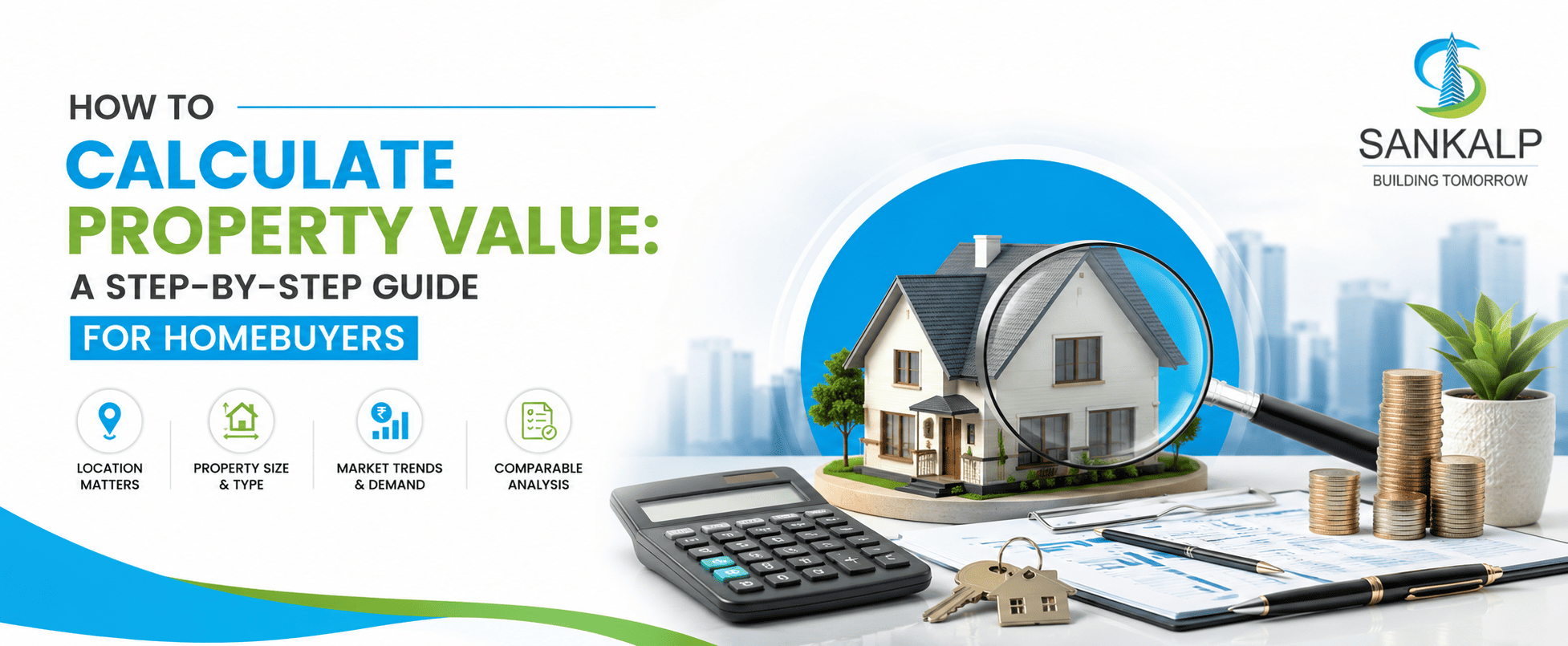
Ask three people what a flat is worth and you will get three answers. The seller quotes one number, the government records another, and the bank may say something different again. Learning to calculate property value yourself puts you on equal footing in that conversation. This guide walks through how valuation actually works in India, step by step, with a simple example you can follow.
Property Price and Property Value Are Not the Same Thing
Start with this distinction, because it explains most of the confusion.
- Price is what the seller is asking, which can be high, low or fair
- Value is what the property is genuinely worth based on evidence
- Circle rate, called DLC rate in Rajasthan, is the government's minimum value for tax purposes
A flat can easily have three different numbers attached to it at the same time. Your job as a buyer is to work out the middle one.
Step 1: Check the Government Rate First
The DLC rate is the simplest number to find and the best starting point. It is the minimum value at which a property can be registered in that locality, and it is revised every year on 1 April.
Look it up free on the e-Panjiyan portal by selecting your district, sub-registrar office, zone and colony. This number matters twice over. It tells you how the government values the area, and your stamp duty is charged on the DLC value or your purchase price, whichever is higher.
The DLC rate is usually below actual market rates, so treat it as a floor, not an answer.
Step 2: Compare Similar Properties
This is the method most valuers rely on, and you can do a simplified version yourself. Find three or four properties similar to the one you are considering, and see what they sold for recently.
For a fair comparison, match on:
- Locality and even the specific street, since rates vary within an area
- Carpet area, not super built-up, so you are comparing real space
- Age of the building, as an older flat is worth less than a new one
- Floor, view and whether it is a corner unit
- Condition and whether it is furnished
Someone comparing flats in Jaipur should look at actual completed transactions where possible, not just asking prices on listing sites. Asking prices are opening positions.
Step 3: Work Out the Rate per Square Foot
Once you have comparable sales, the arithmetic is straightforward.
Take a recently sold flat with a carpet area of 1,000 square feet that sold for Rs 60 lakh. That works out to Rs 6,000 per square foot. If the flat you are considering has a carpet area of 1,200 square feet in the same building, its indicative value is around Rs 72 lakh.
These figures are only for illustration. Use real numbers from your own area, because rates differ sharply between localities and even between floors of the same tower.
Step 4: Adjust for the Specifics
No two flats are identical, so adjust the base figure up or down.
- Higher floors usually command more, though the top floor can attract a discount for heat
- A corner unit with two-side ventilation is worth more
- A well-maintained building holds value better than a neglected one
- Ready to move usually prices above under construction, since there is no delivery risk
- Missing paperwork, such as no occupancy certificate, reduces value sharply
Step 5: Cross-Check with Rent
There is a quick sanity check used in property valuation in India called the rental yield method. Take the annual rent the property could earn and divide it by the price, then multiply by 100.
If a flat rents for Rs 20,000 a month, that is Rs 2.4 lakh a year. Against a price of Rs 60 lakh, the yield is 4 percent, which sits within the range generally reported for Indian cities. A yield far below that range can mean the asking price is inflated.
Step 6: Get a Professional Valuation When It Matters
For a large purchase, a resale with any complication, or a legal or tax requirement, use a registered valuer. Banks also run their own valuation before sanctioning a loan, and that figure is worth knowing, since a lender will fund a percentage of its valuation rather than your agreed price.
If the bank values the property below your purchase price, you will need to bridge the difference yourself, which is a common and unwelcome surprise.
What Actually Moves the Market Value of Property
Understanding the drivers helps you judge whether today's price is reasonable.
- Confirmed infrastructure such as a metro line under construction
- Employment nearby, which supports both rent and resale
- Legal clarity, since a clean title and RERA registration protect value
- Scarcity of land in established areas
- The reputation of the developer, because buildings by the top builders in Jaipur that are well maintained hold value better over time
Property in Jaipur near funded, under-construction infrastructure tends to hold its value better than property near projects that are only announced.
FAQs
1. How can I find the government value of a property?
Check the DLC rate for that exact locality on the e-Panjiyan portal. It is free, and it is the value your stamp duty is calculated on if it exceeds your purchase price.
2. Should I compare properties on carpet area or super built-up area?
On carpet area. It is the real usable space and the legal basis for sale, so comparing on it gives you an honest rate per square foot.
3. Why does the bank's valuation differ from the seller's price?
Banks value conservatively for their own risk. If their figure is lower, they fund a share of that lower number, and you cover the gap.
4. Is the circle rate the same as market value?
No. The circle rate is a government minimum for registration and is usually below the actual market rate, so use it as a floor rather than a final answer.

Anil Shah
The Anil Shah editorial team writes about Jaipur real estate - market trends, home-buying guides, RERA updates and investment insights - drawing on 25+ years of building landmark residential and commercial projects across the city.
Looking for your dream property in Jaipur?
Explore RERA-certified homes & commercial spaces by Sankalp Group. Book a free site visit today.