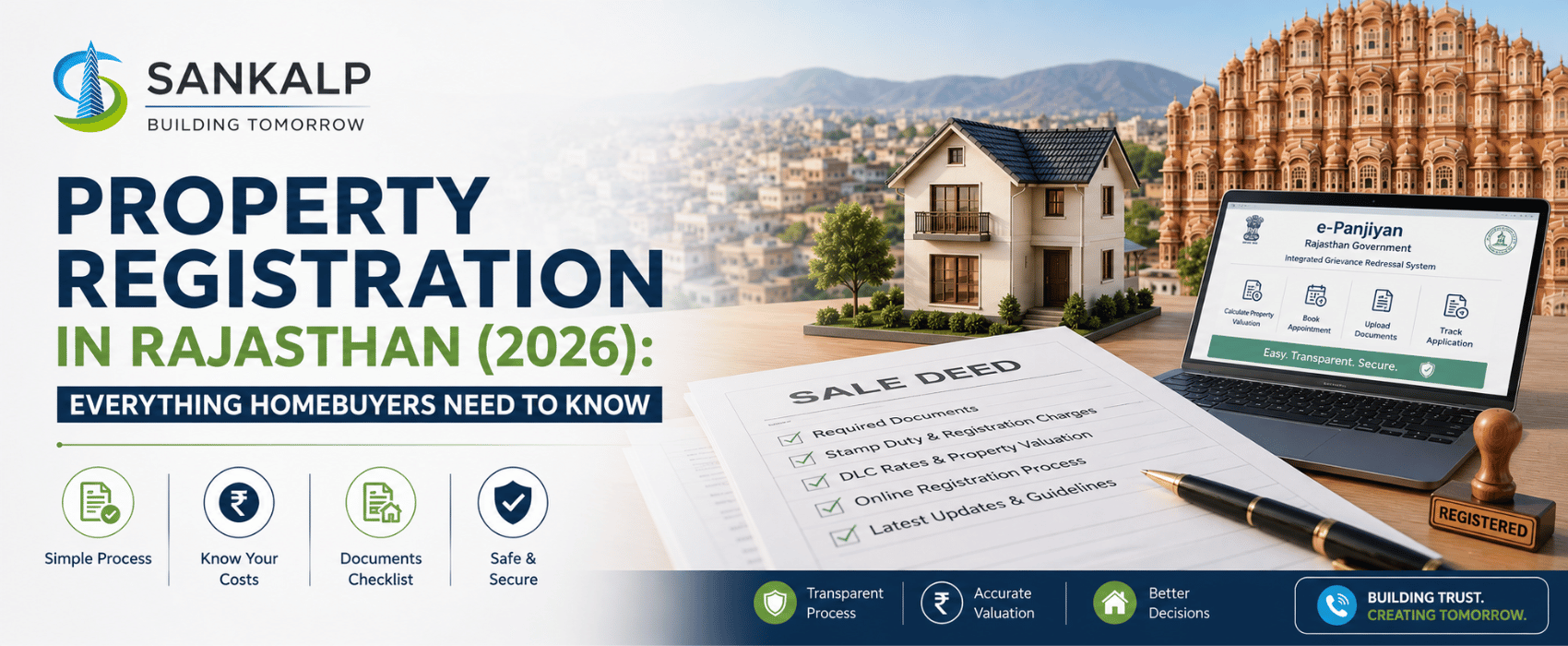
Paying for a flat does not make it yours. The property becomes legally yours only when the sale deed is registered in your name at the sub-registrar office. Until then, you are a buyer on paper with a weak claim. Registration is the step that turns the deal into ownership the law will actually defend, under the Registration Act, 1908.
Rajasthan has moved most of this process online over the last few years, so the day at the registry is far shorter than it used to be, as long as you turn up prepared. Here is what you need to carry, what it costs in 2026, and how the system works now.
The Documents You Need to Keep Ready
Sort these out well before your slot. Missing even one can push your registration to another day.
The sale deed is the heart of it. This document records the transfer from seller to buyer on the correct stamp value, and it has to be registered to take effect. Along with it, both buyer and seller need their Aadhaar and PAN cards for identity and tax checks, plus recent passport-size photographs.
You also need the paper trail behind the property. Previous ownership documents, sometimes called the chain of title, show how the property changed hands before it reached the seller. Then come the property's own records, and which ones apply depends on what you are buying. These can include the patta, the property card, the approved layout or building plan, recent property tax receipts, mutation records from the last transfer, and for farmland, the khasra and related land records. An encumbrance certificate is worth carrying too, since it proves the property is free of loans or legal claims.
A No Objection Certificate matters in some cases, say when a housing society, a development authority, or a lender has to clear the sale. If you are buying with a home loan, keep your loan sanction and bank papers handy, since the lender is usually part of the registration. And registration needs witnesses, so bring the identity proof of the people who will sign as witnesses.
What Registration Costs in 2026
The charges have not changed in structure. A male or joint buyer pays 6 percent stamp duty, a woman buying in her own name pays 5 percent, and on top of that sits a labour cess of 20 percent of the stamp duty. Everyone then pays a flat 1 percent registration fee. Added up, that comes to roughly 8.2 percent of the value for men and about 7 percent for women. All of it is calculated on the higher of your sale price or the DLC rate for the area, so check that rate before you fix your budget.
How the Process Works Now
Most of the groundwork happens online through the e-Panjiyan portal before you ever walk into the office.
You register on the portal, value the property using its built-in valuation tool, enter the payment details, and pay the stamp duty and fees through the e-GRAS system, which produces your e-stamp. After that you upload the required documents and book a time slot at your sub-registrar office. The portal hands you a Citizen Reference Number, or CRN, that ties the whole file together and lets you track its status.
On the booked day, the buyer, seller, and witnesses visit the office. Staff capture photographs and thumb impressions, the sub-registrar checks the details and endorses the deed, and the registration is complete. You can then download the registered sale deed from the portal. One step people forget comes right after: get the property mutated, meaning the ownership updated in the municipal or revenue records, so future tax bills and land records carry your name.
What Has Changed in 2026
The system keeps tilting toward digital. More of the registration now runs online, with valuation, payment, document upload, and slot booking all handled before the office visit. Rajasthan has also brought in automatic deed preparation for sale, gift, lease, and rent documents, and paperless mortgage and rent deeds are now live at full-time sub-registrar offices, which trims the manual drafting.
Documents go in as scanned uploads, usually PDFs, instead of thick physical files. DigiLocker, the Government of India's digital document wallet, helps here as well. Your Aadhaar and PAN stored in DigiLocker count as valid government records and are accepted by departments and banks, so keeping them there means your identity papers are ready the moment verification is needed.
Where to Register and Check the Details
The official portal for all of this is the Rajasthan Registration and Stamps Department's e-Panjiyan site at https://epanjiyan.rajasthan.gov.in, with the department's main page at https://igrs.rajasthan.gov.in. Use it to value your property, check the DLC rate, pay your fees, upload documents, and book your slot.
A little preparation goes a long way. Confirm the DLC rate, keep your documents scanned and ready, check every name and figure on the sale deed twice, and book your slot in advance. Do that, and registering property in Rajasthan is now a mostly online, fairly smooth affair.
FAQs
1. Is stamp duty charged on the sale price or the DLC rate?
On whichever is higher. If your sale price is above the DLC value, duty is charged on the sale price; if the DLC value is higher, it applies to that. Registering below the DLC rate is not allowed and can invite scrutiny.
2. What documents are needed to register a property in Rajasthan?
You typically need the sale deed, identity and address proof (Aadhaar and PAN), passport-size photos, proof of DLC or property value, previous title documents, a no objection certificate where applicable, and proof of stamp duty and fee payment. For a ready flat, keep the completion or occupancy certificate ready too.
3. Where do I register my property in Rajasthan?
Property is registered at the local Sub-Registrar Office for the area where the property is located. Much of the process, including stamp duty and DLC value, can be handled through the e-Panjiyan portal at epanjiyan.rajasthan.gov.in before you visit.
4. How do I check the DLC rate for my property?
Use the e-Panjiyan portal, select your district, tehsil and colony, and choose the property type. Note whether your plot is exterior (main road) or interior, since the rates differ. The Sub-Registrar Office can also confirm the current figure.
5. Can property registration be done online in Rajasthan?
Many steps are digital through e-Panjiyan, including valuation, stamp duty payment and appointment booking, but the final registration usually requires the parties to appear at the Sub-Registrar Office for verification and biometrics. Confirm the current procedure on the portal.

Anil Shah
The Anil Shah editorial team writes about Jaipur real estate - market trends, home-buying guides, RERA updates and investment insights - drawing on 25+ years of building landmark residential and commercial projects across the city.

Looking for your dream property in Jaipur?
Explore RERA-certified homes & commercial spaces by Sankalp Group. Book a free site visit today.