Places to See in Jaipur: Attractions That Make It a Top City to Buy Property
There are so many wonderful places to see in Jaipur that the Pink City draws millions of visitors every year, and many of them leave wishing they could stay. Grand hilltop forts, a honeycomb palace of 953 windows, the world's largest stone sundial, and bazaars bursting with colour, Jaipur wears its royal heritage while pulsing with modern life. This guide walks you through the city's finest attractions, with practical timings and fees, then answers a question a surprising number of visitors end up asking: what would it be like to actually live here? The reasons people fall for Jaipur as a traveller turn out to be the very same reasons it has become one of India's smartest places to buy a home.
Why Jaipur Is a Must-Visit City
Jaipur is the capital of Rajasthan and part of India's famous Golden Triangle, alongside Delhi and Agra. In 2019, the walled city earned a place as a UNESCO World Heritage City, a rare honour that reflects its planned design and living heritage.
The city offers a rich mix for every visitor:
- Majestic forts and palaces
- UNESCO World Heritage monuments
- Colourful bazaars and handicrafts
- Temples, gardens and lakes
- Rajasthani food and culture
This blend is why the places to see in Jaipur never seem to run out, however long you stay.
Best Places to See in Jaipur
Here are the landmark attractions that top every traveller's list. These are the best sights in the city, each with its own story.
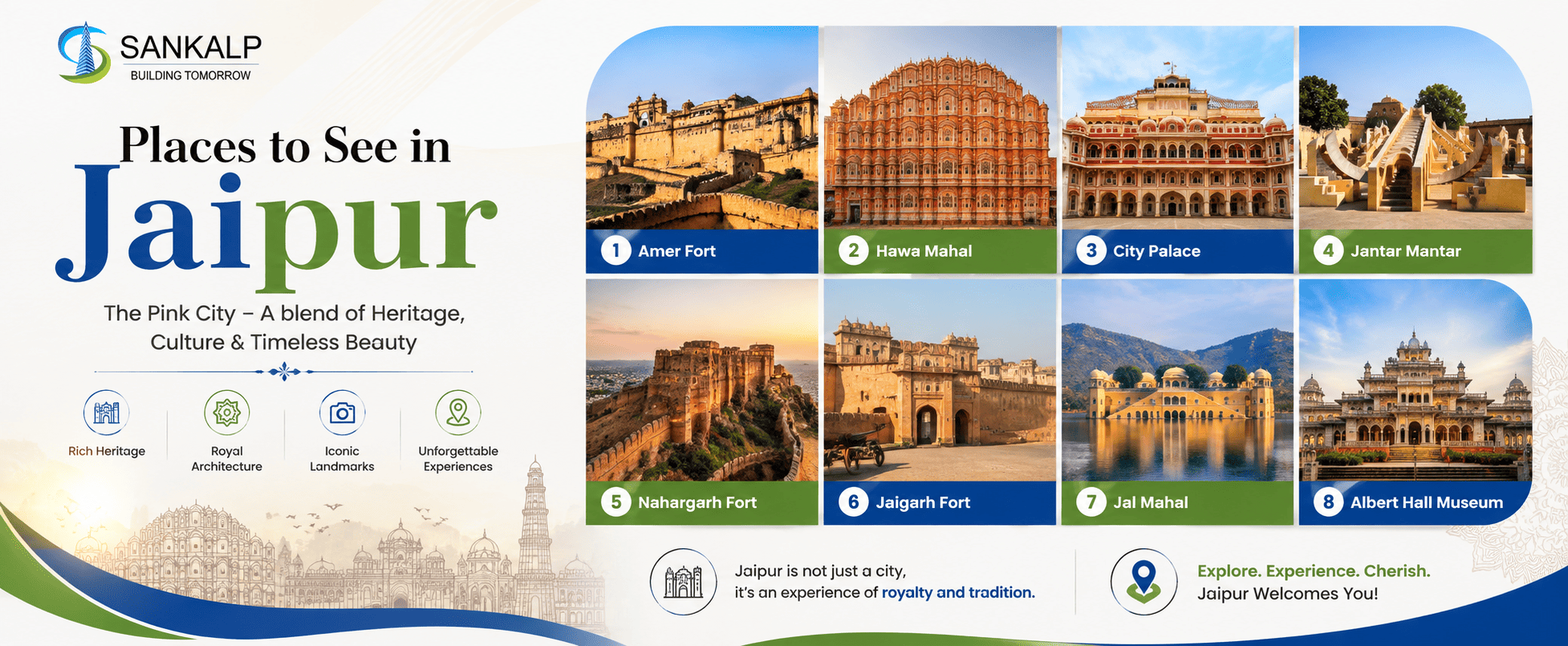
Amer Fort
Perched on the Aravalli hills about 11 km from the city centre, Amer Fort was built in 1592 by Raja Man Singh I. This magnificent Rajput and Mughal fort-palace spreads across roughly 4 square kilometres overlooking Maota Lake, and forms part of the Hill Forts of Rajasthan UNESCO World Heritage listing. Do not miss the Sheesh Mahal, a hall of thousands of tiny mirrors, and the evening light and sound show.

Hawa Mahal
The Palace of Winds is Jaipur's postcard image. Built in 1799 by Maharaja Sawai Pratap Singh and designed by architect Lal Chand Ustad, its five-storey pink sandstone facade has 953 small windows, or jharokhas, shaped like the crown of Lord Krishna. Royal women once watched street processions through them, unseen. A quiet tip: the ornate front is not the entrance, you go in through the Imperial Door on the City Palace side.

City Palace
In the heart of the old city, the City Palace was built by Maharaja Sawai Jai Singh II between 1729 and 1732. This sprawling complex of courtyards, gardens and museums still houses the royal family and displays textiles, weapons and art. It is separately managed, so its ticket works differently from the state monuments.

Jantar Mantar
Next to the City Palace stands Jantar Mantar, a UNESCO World Heritage Site and the largest stone astronomical observatory in the world. Built by Sawai Jai Singh II between 1724 and 1735, its 19 instruments track time and the stars, including the giant Samrat Yantra sundial.

Nahargarh Fort
Standing on the hills above the city, Nahargarh Fort offers sweeping views over Jaipur, especially at sunset. It once formed a defensive ring with Amer and Jaigarh forts.

Jaigarh Fort
Built in 1726 to protect Amer Fort, Jaigarh is known for its massive ramparts and Jaivana, one of the world's largest wheeled cannons.

Jal Mahal
The Water Palace sits serenely in the middle of Man Sagar Lake. Several of its floors remain underwater, and it makes a beautiful stop for photographs on the way to Amer.

Albert Hall Museum
The oldest museum in Rajasthan stands in Ram Niwas Garden, just outside the old walled city. Named after King Edward VII and designed by Sir Samuel Swinton Jacob in the Indo-Saracenic style, it looks especially stunning when lit at night.

More places of interest
Jaipur's list of sights runs long, and these Jaipur places of interest are all worth your time:
- Patrika Gate: the vividly painted gateway to Jawahar Circle, one of India's most photographed spots
- Galtaji Temple: the hillside monkey temple with sacred water tanks
- Birla Temple: a serene white marble temple below Moti Dungri
- Samode Haveli: a heritage haveli showcasing royal Rajasthani style
- Raj Mandir: the iconic cinema, an experience in itself
Timings and Entry Fees for Jaipur Monuments
Most of Jaipur's monuments open daily, roughly from 9 am to 5 pm. Here is a practical guide to help you plan. Fees and timings can change with government updates, so reconfirm at the ticket counter on your visit day.
| Monument | Approx. timings | Indian entry | Foreign entry |
|---|---|---|---|
| Hawa Mahal | 9 am to 5 pm | Rs 50 | Rs 200 |
| Amer Fort | 8 am to 5.30 pm | Check counter | Check counter |
| Jantar Mantar | 9 am to 5 pm | Check counter | Check counter |
| Albert Hall Museum | 9 am to 5 pm | Check counter | Check counter |
A useful money-saver: a two-day composite ticket covers several state-run sites, including Amer Fort, Hawa Mahal, Jantar Mantar, Nahargarh Fort and Albert Hall, and is sold at those premises. City Palace is managed separately and is not part of it. Students often get concessional rates, and entry is free on certain days like World Heritage Day.
Best Bazaars and Shopping
No trip is complete without the markets, and these are the liveliest Jaipur sites to see for shoppers.
- Johari Bazaar: famous for jewellery and gemstones
- Bapu Bazaar: textiles, juttis and Rajasthani prints
- Tripolia Bazaar: bangles, brassware and traditional goods
- Ganpati Plaza: a modern shopping hub on MI Road
These bazaars capture the colour and energy that make Jaipur places to visit at Rajasthan so memorable.
How Many Days Do You Need to Cover the Places to See in Jaipur?
Most travellers find that two days cover the main highlights, the forts, palaces and a bazaar or two. Three days let you explore at a relaxed pace and add temples, museums and food trails. Whether you have a weekend or longer, the range of Jaipur things to visit rewards every kind of traveller.
From Visiting to Living: Why Jaipur Wins Hearts
Here is what many visitors notice: the qualities that make Jaipur a joy to visit also make it a wonderful place to live. The heritage, the wide planned roads, the culture and the warmth stay with you long after the trip ends. It is no surprise that so many people who come to see the city end up wanting to call it home.
Jaipur combines this timeless charm with modern growth, which is a rare and appealing mix for a homebuyer.
Why People Want to Buy Property in Jaipur
The charm is the hook, but the decision to buy rests on hard practicalities, and here Jaipur makes a genuinely strong case. The same city that enchants tourists has quietly become one of India's fastest-growing property markets, and the reasons are concrete.
It is far more affordable than the metros
This is the reason most buyers start with. Property in Jaipur costs a fraction of what the same home would in Delhi, Mumbai or Bengaluru. Reports place Jaipur among the most affordable major cities in India, which means your money buys more space, and a larger home, than it would in a saturated metro. For families priced out of the big cities, that difference is life-changing.
Prices are rising, but you are not too late
Jaipur has ranked among the fastest-growing Tier-2 property markets in the country, with market reports citing strong annual appreciation over recent years. Crucially, prices remain accessible while the city builds the infrastructure that larger metros already have. Analysts often describe this as a value-buy window, you enter before full price maturity, and the city's growth works in your favour. As with any investment, appreciation is never guaranteed, so treat these as reported trends and do your own checks, but the direction of travel is clear.
Infrastructure is transforming the city
Nothing drives property value like infrastructure, and Jaipur has an unusual amount underway at once.
- Metro expansion: Jaipur Metro Phase 2, a major multi-thousand-crore project, will link key residential and commercial zones and lift values near its corridors
- Ring Road: the Jaipur Ring Road is decongesting traffic and opening new investment corridors on the city's edges
- Delhi-Mumbai Expressway: faster access to Delhi NCR and Mumbai is boosting business and logistics around the city
- Airport expansion: a new terminal strengthens Jaipur's national and international links
Each of these makes daily life easier and pushes long-term property values up, which is exactly what a buyer wants working in the background.
Jobs, education and steady demand
Jaipur is no longer just a tourist city. A growing IT and business presence brings professionals, and its universities and colleges bring students, both of which fuel steady housing and rental demand. Migration from other cities for jobs, education and business keeps the buyer pool deep. For an investor, that translates into reliable tenants and a market that holds its value.
A quality of life the metros struggle to offer
Beyond the numbers, there is the life itself. A UNESCO World Heritage City with wide planned roads, clean air relative to the big metros, rich culture, good schools and hospitals, and none of the punishing commutes. This lifestyle is a real, if harder to measure, reason so many people who visit end up moving. Demand for flats in Jaipur has grown steadily as more buyers choose the city for exactly this blend of value, growth and living quality.
The valid reasons to buy, in short
- Affordable entry compared to Delhi, Mumbai and Bengaluru
- Strong reported appreciation in a fast-growing Tier-2 market
- Major infrastructure lifting long-term value
- Deep, steady demand from jobs, education and migration
- A rare quality of life for a growing city
- Gated, RERA-approved projects offering security and amenities
Weigh these together, verify each property, and Jaipur offers something rare: a place that is a joy to live in and a sound place to invest.
Where to Buy a Home Near the Heart of Jaipur
As the city grows, well-planned modern homes are rising in its prime corridors, giving buyers the best of both worlds, heritage nearby and contemporary living at home. Among the top builders in Jaipur, Sankalp Group has developed homes in sought-after locations.
- Spectrum 21, Vaishali Nagar: a landmark 21-floor residential development in an established, well-connected belt, offering modern apartments with premium amenities
- The Index, Jagatpura: a ready-to-move commercial and mixed-use development in one of the city's fastest-growing corridors, close to the education and IT hubs
Buyers looking at apartments in Jaipur, or specifically at flats in Jagatpura, will find these areas combine everyday convenience with easy access to the city's attractions and business districts. Always verify the RERA registration and confirm the current price before booking.
Conclusion
The many places to see in Jaipur, from Amer Fort and Hawa Mahal to Jantar Mantar and the colourful bazaars, tell the story of a city where history feels alive. Few Indian cities pack so many places to see in Jaipur into such a compact, walkable heritage core. That same character, paired with modern connectivity and growth, is why so many visitors return as residents. If Jaipur has captured your heart as a traveller, it may well be the place to plant roots, enjoy the culture, the lifestyle and a home in one of India's most beloved cities.
FAQs
1. What is special to see in Jaipur?
Jaipur is special for its forts and palaces like Amer Fort, Hawa Mahal and the City Palace, its UNESCO-listed Jantar Mantar observatory, and its lively bazaars. As a UNESCO World Heritage City, it offers a rare blend of royal heritage and living culture.
2. Is Jaipur enough for 2 days?
Two days are enough to cover the main highlights, including Amer Fort, Hawa Mahal, the City Palace, Jantar Mantar and a bazaar or two. A third day lets you explore temples, museums and food at a more relaxed pace.
3. Which is the most visited place in Jaipur?
Amer Fort is among the most visited, drawing thousands of visitors daily, along with Hawa Mahal, the City Palace and Jantar Mantar. These landmarks form the core of most Jaipur sightseeing trips.

Anil Shah
The Anil Shah editorial team writes about Jaipur real estate - market trends, home-buying guides, RERA updates and investment insights - drawing on 25+ years of building landmark residential and commercial projects across the city.

Looking for your dream property in Jaipur?
Explore RERA-certified homes & commercial spaces by Sankalp Group. Book a free site visit today.