The rules that catch buyers off guard almost always involve an NRI on the other side of the deal. When you buy property from a resident Indian, you deduct a simple 1 percent TDS. When the seller is an NRI, an entirely different section of the law applies, the rate is higher, and the responsibility sits squarely on you as the buyer. Getting this wrong is expensive, so this guide explains how TDS works on a purchase of property from an NRI, in plain terms.
Why TDS on an NRI Seller Is Different
The confusion starts because most buyers know the resident rule and assume it applies everywhere. It does not.
- For a resident seller, TDS is 1 percent under Section 194-IA, and only on deals of Rs 50 lakh or more
- For an NRI seller, TDS is deducted under Section 195, at capital gains rates, with no minimum threshold at all
- Even a small flat triggers TDS when the seller is an NRI, regardless of value
So the first thing to establish before buying is the seller's residential status, because it changes everything about your tax duty.
The Current Rate on TDS on Property Purchase by NRI
After the Budget 2024 changes, the long-term capital gains rate on property fell, which lowered the related TDS.
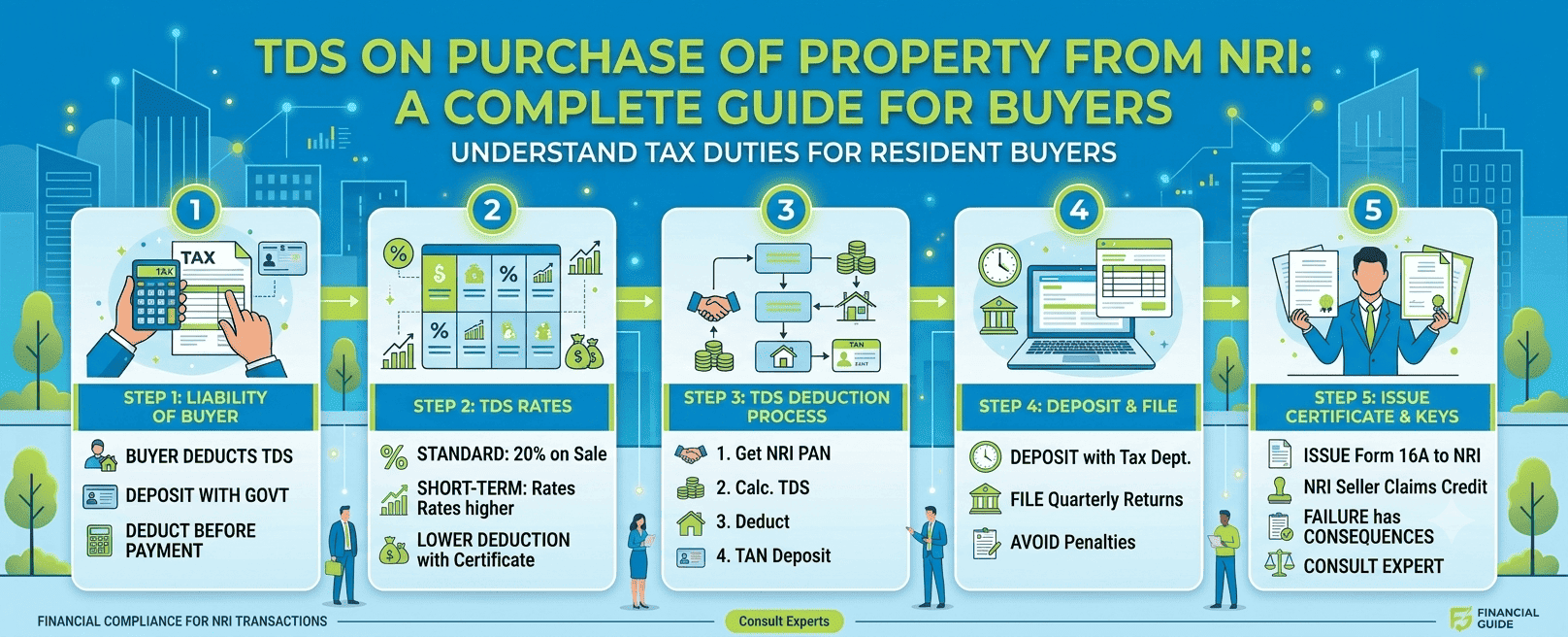
- If the NRI has held the property for more than 24 months, the gain is long-term, and TDS is 12.5 percent plus surcharge and 4 percent cess
- Including surcharge and cess, the effective long-term rate commonly works out to around 13 to 15 percent
- If the property was held for 24 months or less, the gain is short-term and taxed at the NRI's slab rates, which can run much higher
- These rates apply to the sale consideration by default, not just the profit, unless a lower deduction certificate is obtained
Because the exact figure depends on surcharge bands and the capital gains computation, a chartered accountant should calculate it for your specific deal.
What the Buyer Must Actually Do
This is the part first-time buyers underestimate. For tds on purchase of immovable property from an NRI, you carry the compliance.
- Obtain a TAN, the Tax Deduction Account Number, since Section 195 requires it (unlike the resident 1 percent route)
- Deduct the TDS at the time of payment to the seller
- Deposit it with the Income Tax Department and file the return
- Issue the NRI seller a TDS certificate
Missing these steps leaves you, the buyer, liable for interest and penalties, not the seller.
How the NRI Seller Can Reduce the Deduction
A well-informed nri customer on the other side will often ask for this, and it is legitimate.
- The NRI can apply for a Lower Deduction Certificate under Section 197, so tax is deducted on the actual capital gain rather than the full sale value
- This is common on high-value deals, where TDS on the whole price would lock up a large sum
- Once the certificate is issued, you deduct at the reduced rate it specifies
If the seller shows you a valid certificate, deduct at that rate. If not, deduct at the full applicable rate to protect yourself.
PAN Matters, on Both Sides
If the NRI seller does not provide a PAN, the TDS rate rises sharply, so insist on it. Keep clean records of the deduction, the deposit and the certificate, since these support the seller's tax filing and your own compliance.
Where This Fits When Buying in Jaipur
None of this should scare you off a good purchase. It simply means checking the seller's status early. Much of the property in Jaipur is sold by resident developers and owners, where the simple 1 percent rule applies, so Section 195 only comes in on a resale from an NRI seller.
For a new home from a builder, ready to move flats in Jaipur and under-construction units alike usually involve a resident developer, which keeps the tax side straightforward. Buyers looking at flats in Jaipur from a company should confirm the seller entity, and among the top builders in Jaipur, a reputable one will have clean documentation that makes your TDS position clear from the start.
FAQs
1. Does TDS apply when I buy property from an NRI?
Yes. Under Section 195 (now Section 393(2) of the Income-tax Act, 2025 for deals from 1 April 2026), the buyer must deduct TDS on the capital gains, at rates higher than the resident 1 percent, with no minimum value threshold.
2. What is the TDS rate on buying property from an NRI in 2026?
For long-term gains, where the NRI held the property over 24 months, TDS is 12.5 percent plus surcharge and cess, an effective rate commonly around 13 to 15 percent. Short-term gains are taxed at slab rates, up to 30 percent plus surcharge and cess.
3. Do I need a TAN to buy property from an NRI?
Yes. Unlike the resident 1 percent route, buying from an NRI requires you to obtain a TAN before deducting and depositing the TDS. From 1 October 2026, individual and HUF buyers may use a PAN-based challan instead, but a TAN is required until then.
4. Can the NRI seller reduce the TDS?
Yes, by obtaining a Lower Deduction Certificate under Section 197, which allows deduction on the actual capital gain rather than the full sale value. This is a common strategy in higher-value NRI transactions.
A quick note
Tax rules change and each deal differs, so treat this as a general guide, not personal advice. Confirm the current rates and your exact position with a chartered accountant before you complete the purchase.

Anil Shah
The Anil Shah editorial team writes about Jaipur real estate - market trends, home-buying guides, RERA updates and investment insights - drawing on 25+ years of building landmark residential and commercial projects across the city.



Looking for your dream property in Jaipur?
Explore RERA-certified homes & commercial spaces by Sankalp Group. Book a free site visit today.