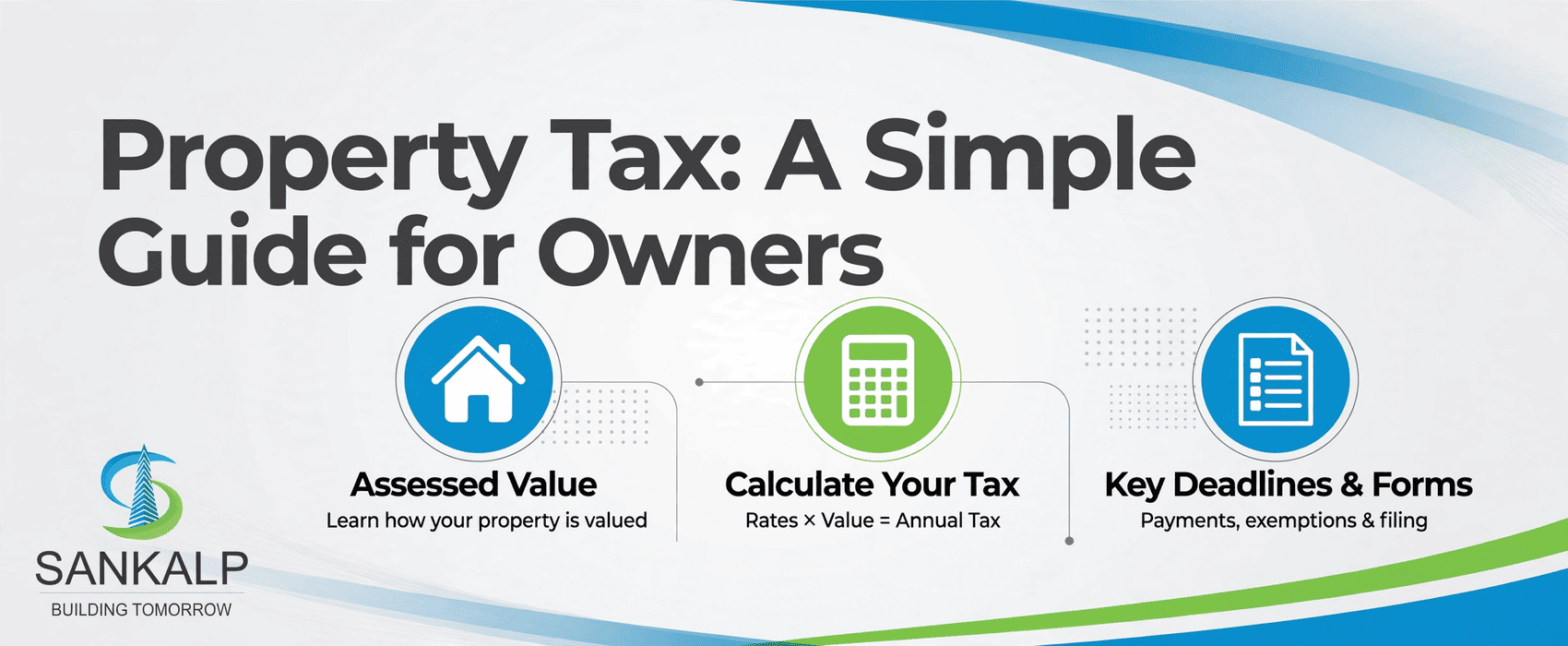
Property Tax: Meaning, Calculation, Online Payment and Rebates
Every year, somewhere in a drawer in your house, there is a bill you probably forgot about until somebody mentioned it.
Property tax is the one cost of owning a home that never goes away. You pay stamp duty once. You pay registration once. But this one comes back every single year for as long as you own the place, and if you ignore it, it quietly grows.
The good news is that it is not complicated once somebody explains it properly. And in Rajasthan, there is a very large group of owners who do not have to pay it at all, which almost nobody tells them.
Let us go through the whole thing in plain language.
What Is Property Tax?
Property tax is an annual charge collected by your local municipal body from people who own property.
It is not collected by the central government or the state government. It is collected by the town or city authority, which means the Nagar Nigam, the Nagar Palika or the Municipal Corporation, depending on where you live.
The money pays for the things around your home that you use without thinking about them. Roads, street lights, drains, garbage collection, parks, water supply and sewerage.
In Rajasthan the tax has a different name. Here it is officially called Urban Development Tax, or UD tax. People still call it house tax or property tax in daily conversation, and all three words mean the same thing.
| Point | Detail |
|---|---|
| What it is | An annual tax on property ownership |
| Who collects it | Your local municipal body |
| Name in Rajasthan | Urban Development Tax, or UD tax |
| Law in Rajasthan | Rajasthan Municipalities Act, 2009 and Urban Development Tax Rules, 2016 |
| How often | Every financial year |
| Due date in Rajasthan | 31 March |
| Where to pay | The municipal portal, or the ward office |
Who Has to Pay Property Tax
The rule is simple. The owner pays, not the tenant.
If you own a flat and rent it out, the property tax is still your responsibility unless your rent agreement clearly says otherwise. Many landlords do pass it on to the tenant by agreement, but the municipal body will always come to the owner if it goes unpaid.
If a property has several owners, they are jointly responsible. The bill does not get split by the corporation. It is one bill, and the owners work out among themselves who pays what.
The Rajasthan Rule Most People Do Not Know
Here is something worth knowing before you go any further, because it may save you from paying anything at all.
In Rajasthan, UD tax does not apply to every property. It applies to residential properties and land above 300 square yards, and to commercial, institutional and industrial units above 900 square feet.
Which means a large number of ordinary homes in Jaipur fall below that line and are simply outside the tax.
If you own a plot smaller than 300 square yards, or a flat below the applicable size limit, you may have no UD tax liability at all. A great many owners of flats in Jaipur are in exactly this position and have never realised it.
Because the thresholds are worded slightly differently in different official notices, do check your own position on the municipal portal or at the ward office rather than assuming. But it is worth checking before you pay anything.
Which Corporation Covers You in Jaipur
This next point trips up more people in Jaipur than anything else, and it is a purely local problem.
Jaipur has two municipal corporations, not one.
There is Jaipur Heritage Nagar Nigam, which covers the walled city and the older areas. And there is Jaipur Greater Nagar Nigam, which covers the newer developments and the outer parts of the city.
Your property falls under one of them, and you must select the correct one when you look up your bill or make a payment. Choose the wrong corporation on the portal and your search will simply return nothing, which people often mistake for having no dues.
If you are unsure which one covers your colony, ask at the ward office once and note it down permanently. You will need it every year.
How Property Tax Is Calculated
Different Indian cities use different methods. Three are common across the country.
Unit Area Value Method
The city fixes a rate per square foot or per square metre for each area or category. Your tax is that rate multiplied by the size of your property, adjusted for factors such as use and age.
Delhi, Bengaluru, Kolkata and several other cities use this.
Annual Rental Value Method
The authority works out what your property could reasonably earn as rent in a year. That figure is called the annual rental value, and the tax is a percentage of it. Whether or not you actually rent the property out makes no difference to the calculation.
Chennai, Hyderabad and several other cities use this approach.
Capital Value System
The tax is a percentage of the property's market value as recorded by the government. When the government revises those values, the tax moves with them.
Mumbai uses this method.
How It Works in Jaipur
In Rajasthan, UD tax is worked out using the DLC rate for the area along with the relevant size of the property. The DLC rate is the government's own minimum valuation for land in each locality, and it is the same rate used to calculate stamp duty in Rajasthan when you buy.
The tax is then applied as a percentage of the resulting value. Rates and multipliers are revised from time to time, so use the calculator on the municipal portal rather than working it out from a figure you read on a website.
What Changes Your Bill
| Factor | Effect |
|---|---|
| Size of the plot or built-up area | The single biggest factor |
| Location and DLC rate of the area | A better locality means a higher rate |
| Use of the property | Commercial is charged more than residential |
| Type of construction | Pucca construction is valued higher than temporary |
| Age of the building | Older buildings sometimes get relief |
| Occupancy | Self occupied and rented are treated differently in some cities |
Property Tax on Different Property Types
| Property type | Position |
|---|---|
| Flat or apartment | Charged on built-up area, subject to size limits |
| Independent house | Charged on plot area and construction |
| Vacant plot | Taxed in many cities, often at a lower rate |
| Commercial shop or office | Higher rate than residential |
| Industrial unit | Separate category and rate |
| Agricultural land | Generally outside municipal property tax |
Property Tax on Under Construction Property
This question comes up constantly and the answer is fairly clear.
Until the building is complete and possession is handed over, the property is the developer's responsibility. The liability generally shifts to you once the occupancy certificate is issued and you take possession.
So when you collect your keys, ask for two things. A copy of the occupancy certificate, and confirmation that municipal dues up to the handover date have been cleared. Any established real estate developer in Jaipur will have both ready.
Property Tax Is Not Stamp Duty
People mix these up all the time, so let us separate them clearly.
| Stamp duty | Property tax | |
|---|---|---|
| When you pay | Once, at purchase | Every year |
| Paid to | The state government | The municipal body |
| Based on | Sale value or DLC rate | Property size, location and use |
| What it does | Registers the transfer | Funds local services |
Two completely different payments. Paying one has no effect on the other.
How to Pay Property Tax Online
The General Process
Most municipal bodies across India now follow a similar path.
- Open your municipal corporation's official portal.
- Find the property tax or UD tax section.
- Select the correct local body. In Jaipur this means choosing Heritage or Greater.
- Enter your property identification details.
- Check the property details and the amount shown.
- Apply any rebate you are entitled to.
- Pay by net banking, card or UPI.
- Download the receipt immediately.
In Rajasthan, UD tax services are available through the state's local self government online services portal, which handles all municipal bodies in one place.
Finding Your Property ID or Service Number
This is the step where people get stuck.
Your property ID number, sometimes called the service number or assessment number, is the unique identifier for your property in the municipal records. It appears on any earlier tax receipt, so the easiest route is to find last year's.
If you do not have one, most portals let you search using other details instead. Ward number, colony name, apartment name, owner name, or the book and page number from the municipal register. Enter what you have and the system will usually find you.
Paying Offline
The counter still works perfectly well, and for some people it is easier.
Visit your ward office with your previous receipt or property details, get the amount calculated, pay at the counter, and collect the stamped receipt. Keep it safe.
How to Download Your Property Tax Receipt
Once payment goes through, download the receipt straight away rather than assuming you can get it later.
You will need it for several things. Applying for a home loan. Selling the property. Getting utility connections transferred. Applying for mutation. And proving to the next buyer that nothing is outstanding.
Most portals also keep a payment history section where you can pull up older receipts using your service number.
Keep a digital copy as well as a paper one. A receipt you cannot find is a receipt you do not have.
Exemptions and Concessions
Beyond the size thresholds discussed earlier, several categories receive relief. These vary from city to city, so treat this as a list of things to ask about rather than a guarantee.
- Properties below the prescribed size limits
- Agricultural land
- Places of worship and recognised charitable institutions
- Government owned buildings
- Certain properties owned by ex-servicemen or freedom fighters
- Relief for senior citizens in some cities
- Relief for owners with disabilities in some cities
In Jaipur, women property owners receive a rebate, which makes putting a property in a wife's or mother's name worth discussing within the family. The same consideration applies at purchase, since women also receive a concession on stamp duty in Rajasthan.
Due Dates, Rebates and Early Payment Discounts
This is the section that saves you money, so it is worth reading carefully.
In Rajasthan the financial year ends on 31 March, and that is the last date for paying UD tax for the year.
But paying on the last date means paying full price. Paying early means paying less.
| Rebate | Typical position in Jaipur |
|---|---|
| Early payment | Around 10 percent, for payment before the cut-off date |
| Woman owner | Around 10 percent |
| Both together | Up to around 19 percent |
An early payment window generally runs in the first quarter of the financial year, so somebody who pays in May or June rather than March can save close to a fifth of the bill. For a large property, that is a meaningful amount for doing nothing more than paying a few months sooner.
Rebate percentages and cut-off dates are revised each year, so check the current position on the portal at the start of the financial year rather than relying on last year's numbers.
Penalties for Paying Late
Late payment attracts interest. In Rajasthan this has been charged at around 10 percent a year on the outstanding amount.
Interest is only the beginning. Continued non payment can lead to notices, recovery proceedings and, in serious cases, action against the property itself. Municipal bodies in Jaipur have run inspection drives specifically targeting large defaulters.
The arithmetic is uncomfortable when you look at it plainly. Paying early saves you around 19 percent. Paying late costs you around 10 percent. The gap between the two is nearly a third of your bill.
Amnesty and One Time Settlement Schemes
If you have old dues sitting on a property, watch for these.
Rajasthan has periodically announced schemes offering a full waiver of interest for owners who clear their UD tax in a lump sum, and in some cases a substantial discount on the principal for very old dues.
These schemes have deadlines and they are not permanent. If you are carrying arrears, it is worth asking at your ward office whether a scheme is currently running before you pay the full amount.
Property Tax Across Indian Cities: What Changes
Property tax is a municipal subject, which means it can differ between two cities in the same state.
| What varies | Examples |
|---|---|
| The name | UD tax in Rajasthan, house tax elsewhere, property tax generally |
| The method | Unit area, annual rental value, capital value |
| The rate | Set by each municipal body |
| Exemption limits | Very different from city to city |
| Rebates | Different percentages and different windows |
| Due dates | Usually tied to the financial year, but not always |
So an article about property tax in Mumbai will not tell you what you owe in Jaipur. Always check your own municipal body.
Property Tax After You Buy a Property
Arrears Pass to the Buyer
This is the most expensive thing in this entire article, so please read it twice.
Unpaid property tax attaches to the property, not to the person who ran up the bill.
Buy a flat that carries five years of unpaid dues and those dues become your problem. The municipal body will pursue the property, and the previous owner will be very difficult to find once he has your money.
So before you pay any token amount, ask the seller for a no dues certificate from the municipal body and for the latest paid receipt. Read them alongside the encumbrance certificate and the title documents.
This one check takes a day. Skipping it has cost people lakhs.
Why Bills Still Go to the Previous Owner
You bought the flat. You registered the sale deed. So why does the tax notice still carry somebody else's name?
Because registration and municipal records are two separate systems. Registering your sale deed records the transaction. It does not update the municipal register.
That needs a separate step called mutation, which in Rajasthan is called namantaran. Until you apply for it, the corporation continues to believe the previous owner holds the property.
How to Change the Name on Property Tax Records
The process is straightforward once you know it exists.
- Apply to your municipal body with the registered sale deed
- Attach the mutation order where you have one
- Provide your identity proof
- Attach the latest paid tax receipt
- Pay the small fee and collect the acknowledgement
- Follow up until the change appears in the record
Do this within weeks of registration, not years. It is a small job that becomes a large one with time.
Common Problems and How to Fix Them
| Problem | What to do |
|---|---|
| Wrong area recorded | File a correction application with your measurement documents |
| Bill still in the previous owner's name | Apply for name change with the sale deed and mutation order |
| Duplicate bills received | Take both to the ward office and get the records merged |
| Arrears from before your purchase | Raise it with the seller, and check for any amnesty scheme |
| Search shows no record | In Jaipur, check you selected the correct corporation |
| Property ID not known | Search by ward, colony or owner name on the portal |
| Notice received unexpectedly | Do not ignore it. Visit the ward office with your receipts |
Property Tax and Income Tax Are Not the Same Thing
Property tax is a municipal charge on ownership. Income tax is a central government tax on income.
They meet at one point, which is worth knowing if you rent out your property.
When you calculate your income from house property for income tax purposes, the municipal taxes you have actually paid during the year are deductible from the rental income. You can also claim a standard deduction of 30 percent of the remaining value towards repairs and maintenance, whether or not you actually spent it.
The key word is paid. Tax that you owe but have not paid does not qualify. So a landlord who pays his property tax on time gets a small benefit at income tax time as well.
Property Tax When You Rent Out Your Property
The owner remains liable to the municipal body. That does not change no matter what your rent agreement says.
What the agreement can do is decide who bears the cost between you and your tenant. Write it down clearly, because a verbal understanding about who pays an annual bill will eventually be forgotten by somebody.
Whatever you agree, keep the payment in your own name and keep the receipt. You will need it for your income tax return, and the next buyer will want to see it too.
Checklist for New Property Owners
- Find out whether your property is even above the taxable size limit
- Identify which municipal corporation covers your property
- Obtain your property ID or service number and write it down somewhere permanent
- Get a no dues certificate from the seller before you pay any token amount
- Apply for mutation soon after registration
- Apply for the name change in municipal records
- Pay within the early rebate window every year rather than in March
- Download and store every receipt, digitally and on paper
- Check each year whether the rebate percentages or dates have changed
Property Tax for NRI Owners
If you live abroad and own property in India, the liability is exactly the same. Being outside the country changes nothing.
Online payment has made this far easier than it used to be. The portals accept payment from anywhere, and the receipt can be downloaded immediately.
Two practical suggestions. Set a reminder in your calendar for the early rebate window, since it is easy to lose track of an Indian financial year from another time zone. And ask a family member or your property manager to keep a paper copy of each receipt, because you will need one eventually.
FAQs
1. What is meant by property tax?
It is an annual tax collected by your local municipal body from property owners, used to fund roads, drains, street lighting, garbage collection and other local services. In Rajasthan it is officially called Urban Development Tax.
2. How much is property tax in Jaipur?
There is no single figure, because it depends on your plot size, locality and the applicable DLC rate. Many smaller residential properties fall below the taxable threshold and pay nothing at all. Use the calculator on the municipal portal for your own property rather than relying on a general figure.
3. Is property tax tax free?
No, but a great many properties are exempt. In Rajasthan, residential properties and land below the prescribed size threshold fall outside UD tax entirely, along with agricultural land, places of worship and certain institutional categories.
4. How do I pay property tax in Jaipur?
Through the municipal portal. Select whether your property falls under Jaipur Heritage or Jaipur Greater, enter your service number or search using your ward and colony details, check the amount and pay online. You can also pay at your ward office.
5. How can I calculate my house tax?
Find your property's size and the DLC rate for your locality, then apply the rate and any applicable factors. The simplest and most reliable method is the calculator on your municipal portal, since the multipliers change from time to time.
6. What is the difference between property tax and land tax?
Property tax covers land together with any building on it and is charged by the municipal body. Land tax or land revenue generally refers to a charge on agricultural land, handled by the revenue department. Different authorities, different rules.
7. How much does it cost to register a property in Jaipur?
Registration involves stamp duty calculated on the higher of the sale value or the DLC rate, plus a registration fee and a labour cess. That is entirely separate from property tax and is a one time cost at purchase.
8. How do I calculate property tax on a residential property?
Establish the plot or built-up area, find the DLC rate for the locality, apply the rate and factors prescribed by your municipal body, then deduct any rebate you qualify for. Check the exemption threshold first, since you may not be liable at all.
9. What is another name for property tax?
House tax is the most common alternative. In Rajasthan it is officially Urban Development Tax or UD tax. Some states call it municipal tax or holding tax.
10. Do I need to pay property tax every year in India?
Yes, for as long as you own the property and it falls within the taxable category. Unlike stamp duty, which you pay once, this one returns every financial year.
Before You File This Away
Property tax is small compared to what you paid for your home. That is exactly why it gets forgotten, and why it causes trouble.
Three habits will keep you out of difficulty for as long as you own the place.
Find out whether you are even liable, because in Rajasthan a great many owners are not. Pay within the rebate window rather than at the deadline, which is money saved for doing nothing more than paying early. And before you ever buy another property, ask for the no dues certificate, because somebody else's unpaid bill becomes yours the day you sign.
None of that takes more than an afternoon a year.
Note:- This article is general information for property owners and not legal or tax advice. Rates, thresholds, rebate percentages and due dates are set by individual municipal bodies and are revised from time to time. Please check the current position on your municipal portal or at your ward office before making any payment.

Anil Shah
The Anil Shah editorial team writes about Jaipur real estate - market trends, home-buying guides, RERA updates and investment insights - drawing on 25+ years of building landmark residential and commercial projects across the city.
Looking for your dream property in Jaipur?
Explore RERA-certified homes & commercial spaces by Sankalp Group. Book a free site visit today.