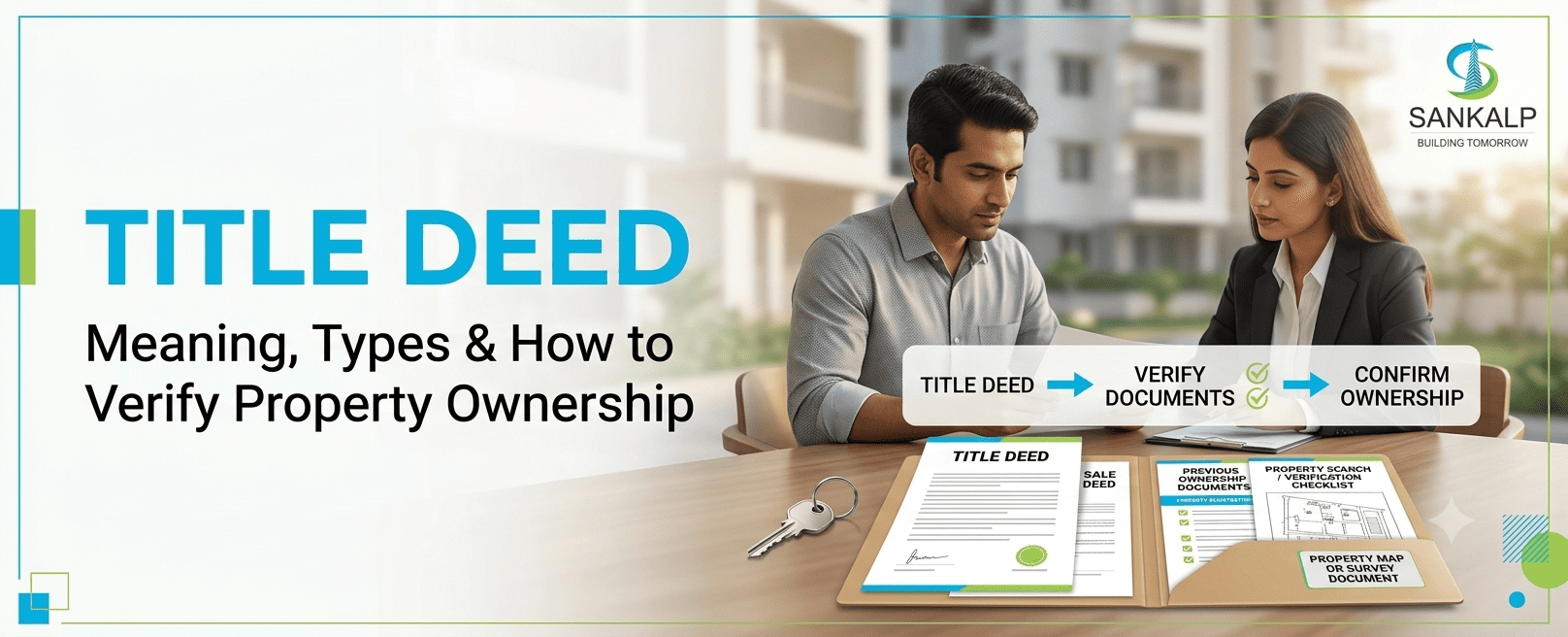
Title Deed: Meaning, Types and How to Verify Property Ownership
Here is something most property articles will not tell you plainly.
In India, there is usually no single document called a title deed.
People ask for one all the time. Brokers promise it, buyers demand it, and banks list it on their checklists. But when you go looking, you will not find a government office that issues a paper with "Title Deed" printed at the top. What you will find is a sale deed, or a gift deed, or a partition deed, or a patta.
Those documents are the title deed. The phrase describes a category, not a form.
Once that clicks, the whole subject becomes much easier. This guide explains what a title deed actually is, which documents count as one, how to check whether a title is clean, and what to do when something goes wrong.
What Is a Title Deed?
A title deed is any legal document that shows how a person came to own a property and proves that ownership.
The word title means the legal right to own something. The word deed means a written instrument that transfers or records that right. Put them together and you get any registered document that establishes who owns a property and how they got it.
In Hindi people often say malikana dastavez, which carries the same sense: the paper that shows who the owner is.
| Point | Detail |
|---|---|
| What it is | Any document proving legal ownership of property |
| Is it one specific form | No. Several documents qualify |
| Most common example | The registered sale deed |
| Issued by | Not issued. It is executed between parties and registered |
| Where registered | Sub-Registrar office |
| Main laws | Transfer of Property Act, 1882 and Registration Act, 1908 |
| Hindi term | Malikana dastavez |
| Must it be registered | Yes, for any transfer of immovable property of meaningful value |
Is a Sale Deed a Title Deed?
Yes. This is the question people search most, so here is the direct answer.
When you buy a flat and get the sale deed registered, that sale deed becomes your title deed. It is the document that proves you own the property and shows exactly how you got it.
The two words are not interchangeable in every case though, and the difference is worth understanding.
| Point | Sale deed | Title deed |
|---|---|---|
| What it means | One specific instrument recording a sale | A category of documents proving ownership |
| Covers | Only a sale transaction | Sale, gift, partition, inheritance, allotment and more |
| Is one the other | Every sale deed is a title deed | Not every title deed is a sale deed |
| Registered | Yes, compulsorily | Yes, where it transfers property |
So if someone inherited a house through a will, their title deed is not a sale deed at all. If someone received land as a gift, the gift deed is their title deed.
Key Components of a Title Deed
Whatever form it takes, a proper title document carries the same building blocks.
| Component | What it records |
|---|---|
| Title and date | What kind of deed it is and when it was executed |
| Parties | Full details of the transferor and the transferee |
| Recital | How the seller came to own the property in the first place |
| Consideration | The amount paid, where a sale is involved |
| Operative clause | The actual words that transfer the right |
| Property schedule | Exact description, area, boundaries, Khasra or plot number |
| Possession clause | When physical possession passes |
| Indemnity clause | Seller covers claims relating to the earlier period |
| Witnesses | Two witnesses with details and signatures |
| Registration endorsement | Sub-Registrar seal, number, date and page details |
The recital is the part most buyers skip and lawyers read first. It is where the chain of ownership begins.
Why a Title Deed Matters
- It proves you own the property. Possession, payment receipts and a builder's letter do not. This does.
- Banks will not lend without it. The original goes to the lender as security during a home loan.
- You cannot sell without it. The next buyer's lawyer will ask for it and for everything before it.
- It settles disputes. When two people claim the same property, the registered deed decides who is right.
- It supports every other step. Mutation, property tax transfer, utility connections and society membership all trace back to it.
Main Types of Title Deeds
Sale deed
The most common. Records a purchase and transfers ownership for a price. In Rajasthan people often call it bainama or vikray patra.
Gift deed
Transfers property without payment, usually within a family. Must be registered to be valid for immovable property.
Partition deed
Divides jointly held property among co-owners, giving each a separate title to their share.
Relinquishment deed
One co-owner gives up their share in favour of another co-owner. Common in inherited property.
Settlement deed
Records a family settlement, usually to avoid future disputes over how property will be shared.
Deed of conveyance
A broader term covering any transfer of title. In housing projects it also refers to the document by which a builder transfers the land and common areas to the society or association.
Will and succession documents
Where property passes on death, the title flows from the will, or from succession and legal heir documents where there is no will.
Lease deed and allotment papers
Where land is held on lease from a government body such as the JDA or a UIT, the lease deed and allotment letter form the title chain. This is common in property in Jaipur and worth understanding properly, because a leasehold holder does not own the land outright.
Patta
In Rajasthan and some southern states, a patta issued by a local body or development authority records the holding. It is an important title document, though it works alongside other papers rather than replacing them.
Title Deed vs Patta vs Khata
These three get mixed up constantly, so here is the clean version.
| Document | What it proves | Issued or executed |
|---|---|---|
| Title deed | Ownership and how it was acquired | Executed between parties, then registered |
| Patta | The holding recorded by a local body or development authority | Issued by the authority |
| Khata | An account for property tax purposes, mainly in southern states | Issued by the municipal body |
| Jamabandi | The revenue record of rights for land | Maintained by the revenue department |
A patta or khata tells you what the government's records say. A title deed tells you what actually happened between the parties. You want both to agree.
What Is a Mother Deed?
A mother deed, also called the parent document, is the earliest available deed in the ownership chain. It is where the story starts.
If a plot passed from A to B in 1994, from B to C in 2008, and from C to you last year, the 1994 deed is the mother deed. Your sale deed is the latest link. Together they form the chain of title.
Lawyers ask for the mother deed because a break anywhere in the chain weakens everything after it. If B's purchase from A was never properly registered, then C had nothing clean to sell you, however perfect your own deed looks.
| Term | Meaning |
|---|---|
| Mother deed | The earliest deed in the chain |
| Chain of title | The full sequence of transfers over the years |
| Clear title | An unbroken chain with no unresolved claims |
| Title defect | Any gap, dispute or irregularity in that chain |
How to Obtain a Title Deed
If you are buying property. Your lawyer drafts the deed, you pay stamp duty calculated on the higher of the transaction value or the applicable DLC rates, and both parties execute it before the Sub-Registrar. Once registered, you collect the original. That is your title deed.
If you inherited the property. The title flows from the will, or from a succession or legal heir certificate. Get the relevant documents in order, then apply for mutation so the records match.
If you need a copy of an old deed. Any registered document can be obtained as a certified copy from the Sub-Registrar office where it was registered. In Rajasthan, registration services run through the e-Panjiyan system of the Registration and Stamps Department.
If the original is with your bank. During a home loan the lender holds the original as security. You are entitled to get it back after closure, and there is a specific rule about that which is covered further down.
How to Verify a Title Deed
This is the section worth reading twice, because verification is where money is saved.
Start with the deed itself. Check that the seller's name matches his identity documents letter for letter. Check that the property description, area and boundaries match the actual property. Check that the registration endorsement, number and date are present.
Trace the chain backwards. Ask for the previous deeds going back as far as you reasonably can. Thirty years is the standard lawyers work with for older property. Each transfer should connect cleanly to the one before it.
Pull the encumbrance certificate. The encumbrance certificate lists every transaction registered against the property for a period you choose, including mortgages and court attachments. A title deed shows you one transfer. The EC shows you everything that was registered.
Check the revenue and local records. Jamabandi, Khasra, mutation entries and patta should all name the same person as the deed does.
Check the approvals. For a built property, ask for the approved plan and the occupancy certificate. For a project, verify the registration on the RERA site.
Get a title search report. For anything large or complicated, a property lawyer examines the chain and gives a written opinion. It costs a fraction of what a title dispute costs.
| Check | What it tells you |
|---|---|
| The deed | Who sold, who bought, what and when |
| Chain of earlier deeds | Whether ownership passed cleanly over the years |
| Encumbrance certificate | What loans or claims are on record |
| Jamabandi and mutation | Whether government records agree |
| Approved plan and occupancy certificate | Whether the building is legal |
| RERA registration | Whether the project is disclosed and approved |
| Title search report | A lawyer's opinion on all of the above |
Buyers of ready to move flats in Jaipur often receive most of this file at possession, since a serious real estate developer in Jaipur keeps the approvals and land papers together. For resale property you will have to assemble it yourself.
How to Correct Errors in a Title Deed
Mistakes happen. A misspelled name, a wrong plot number, an incorrect area figure, a missing boundary detail.
For small factual errors, the parties execute a rectification deed, sometimes called a correction deed. It refers to the original deed, states the error, sets out the correction, and is registered the same way. Both parties must sign, which is why correcting an error ten years later is harder than correcting it in the same month.
For errors the registering officer made, the Sub-Registrar office can often correct the record directly.
Where the other party refuses to cooperate, or the error goes to something substantial such as the identity of the property, you may need a court order.
Three practical points. Act early, because tracing a seller years later is the hard part. Keep the rectification deed with the original, since they are read together. And check the deed carefully before you sign it, which is the only step that avoids all of this.
Common Title Deed Problems and What to Do
| Problem | What to do |
|---|---|
| Original deed lost | File a police complaint, publish a newspaper notice, prepare an affidavit and indemnity bond, and obtain a certified copy from the Sub-Registrar |
| Name spelling differs across documents | Affidavit explaining the difference, or a rectification deed where the deed itself is wrong |
| Break in the chain of title | Get a title search report and legal advice before proceeding |
| Deed not registered | Serious problem. An unregistered transfer of immovable property does not pass title |
| Seller offers a power of attorney instead | Walk away. A GPA is authority to act, not a transfer of ownership |
| Property still mortgaged | Ask for the bank NOC and the registered release deed |
| Revenue record shows a different name | Mutation was never done. Fix it before you buy |
| Deed held by a bank | Get written acknowledgement that the lender holds the original |
Getting Your Original Deed Back After a Home Loan
This one deserves its own paragraph because so many people struggle with it.
Since 1 December 2023, the Reserve Bank has required banks and NBFCs to release all original property documents and remove registered charges within thirty days of full repayment or settlement of a loan. If the delay is the lender's fault, the borrower is entitled to compensation of five thousand rupees for every day of delay. Where documents have been lost or damaged, the lender must help you obtain certified copies and bear the cost, in addition to paying compensation.
So if your loan closed two months ago and your deed is still sitting in a branch, you are not being unreasonable. Put the demand in writing, cite the rule, and escalate to the banking ombudsman if needed.
Where the Title Deed Sits in Your Document File
A title deed does not work alone. It sits alongside the other papers in a purchase.
| Document | What it adds |
|---|---|
| Sale agreement | The terms agreed before the transfer |
| Encumbrance certificate | Registered loans and claims |
| Jamabandi and mutation | What government records say |
| Patta or lease deed | The holding as recorded by the authority |
| Occupancy certificate | Whether the building is fit to occupy |
| Property tax receipts | Dues position |
| Approved plan | What was legally sanctioned |
Remember the order of events. You sign an agreement, you verify, you pay stamp duty in Rajasthan on the higher of the value or the DLC rate, you register the deed, and then you apply for mutation so the records catch up. The deed makes you the owner. Mutation makes the records agree.
Checklist Before You Buy
- Ask for the original title deed, not a photocopy
- Match the seller's name to his ID, letter for letter
- Read the recital and understand how the seller got the property
- Ask for earlier deeds and trace the chain back
- Pull an encumbrance certificate for at least thirteen years, thirty for older property
- Check that the revenue record names the same person
- For a flat, ask for the approved plan and occupancy certificate
- For a project, verify it on the RERA portal
- Get a title search report for anything large or complicated
- Never accept a power of attorney as a substitute for a deed
FAQs
1. What is called a title deed?
Any registered document that proves legal ownership of a property and shows how the owner acquired it. A sale deed, gift deed, partition deed, relinquishment deed or conveyance deed all serve as title deeds depending on the situation.
2. What is a title deed versus a sale deed?
A sale deed is one specific document that records a purchase. Title deed is the wider category covering every document that proves ownership. Every sale deed is a title deed, but a title deed could equally be a gift deed or a partition deed.
3. Is a title deed mandatory?
Yes, in practice. Without a registered document proving ownership you cannot sell, mortgage or defend the property. A transfer of immovable property that is not registered does not pass ownership, whatever else was agreed.
4. How do I get a title deed of property in India?
Through a registered transfer. Your lawyer drafts the deed, you pay the applicable stamp duty, and both parties execute it before the Sub-Registrar. For inherited property the title flows from the will or succession documents instead. For a copy of an existing deed, apply to the Sub-Registrar office for a certified copy.
5. Are a title deed and a mother deed the same?
No. A mother deed is the earliest deed in the ownership chain, sometimes decades old. Your title deed is the current document in your name. Both matter, because a buyer's lawyer reads the whole chain, not just the latest link.
6. Can a title deed help in obtaining a loan or mortgage?
Yes. It is the central document in any property-backed loan. The lender examines it along with the earlier deeds and the encumbrance certificate, then holds the original as security until the loan is repaid. Without a clean title, the loan will not be sanctioned.
Keep the Paper Safe
A title deed is a single document, often only a few pages, that decides who owns something worth many years of your income.
Keep the original somewhere secure and keep a scanned copy where you can find it. Read it once carefully rather than filing it away unread. Check your name spelling the day you receive it, because correcting it that week is simple and correcting it in ten years is not.
Possession is not ownership. Payment is not ownership. The registered deed in your name is.
Look after it.

Anil Shah
The Anil Shah editorial team writes about Jaipur real estate - market trends, home-buying guides, RERA updates and investment insights - drawing on 25+ years of building landmark residential and commercial projects across the city.

Looking for your dream property in Jaipur?
Explore RERA-certified homes & commercial spaces by Sankalp Group. Book a free site visit today.