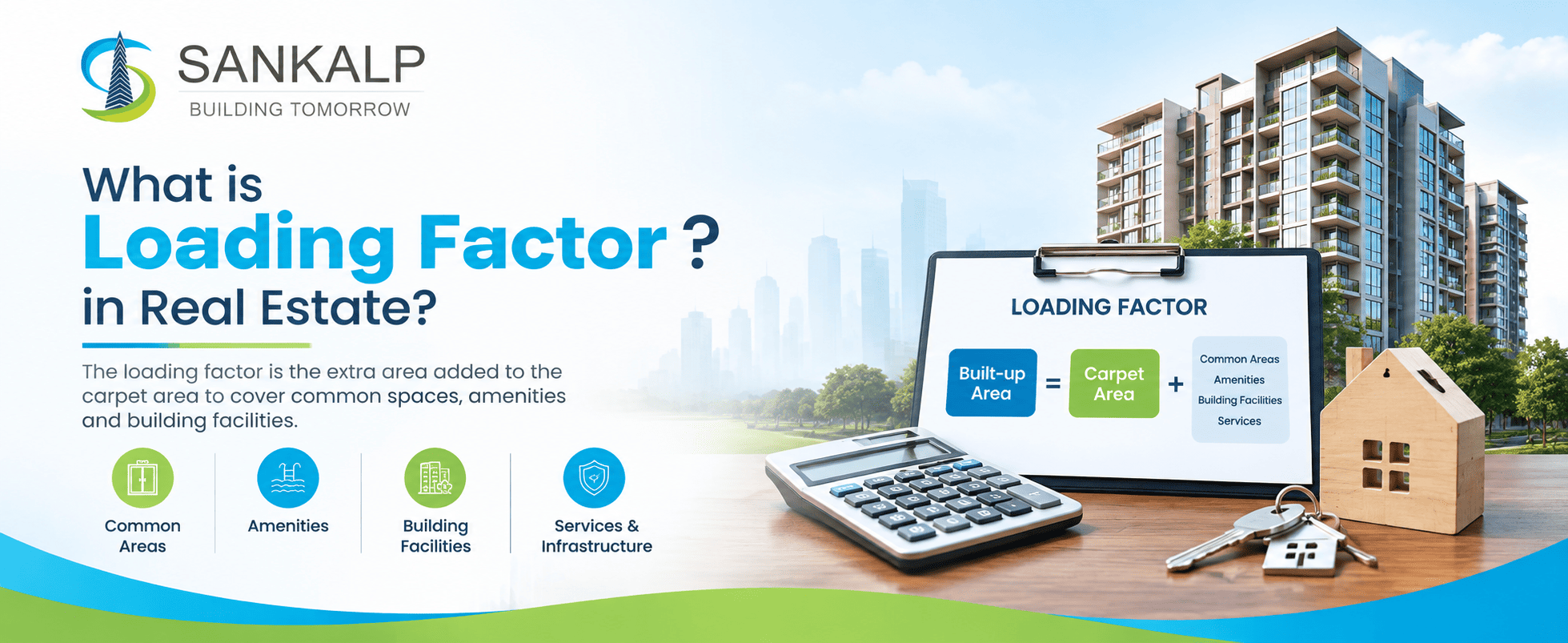
Loading Factor in Real Estate: Meaning, Formula & Limits
A couple once walked through a 1,250 square foot flat and told me it felt smaller than the 1,150 they had seen the week before.
They were right. It was smaller.
Not in the brochure. In real life.
The reason has a name, and it is the loading factor. It explains why two flats can carry the same price tag and give you very different amounts of space to actually live in. It is the single most misunderstood number in Indian real estate, and almost nobody hears the word until the day they are asked to sign a booking form.
Let us go through it properly.
What Is Loading Factor?
Loading factor is the gap between the area you pay for and the area you can actually use, expressed as a percentage.
When you buy a flat, you are not only buying the space inside your four walls. You are also buying a share of the lobby, the staircase, the lifts, the corridors and whatever amenities the project offers. That share gets added to your flat's usable area, and the total is what appears in the price calculation.
That addition is the loading. The percentage it represents is the loading factor.
This is not a trick, and it is not illegal. Every building needs a lobby and a lift shaft, and somebody has to pay for them. The problem is not that loading exists. The problem is that most buyers have no idea what their number is.
| Point | Detail |
|---|---|
| What it is | The difference between super built-up area and carpet area |
| Shown as | A percentage |
| Who decides it | The developer, project by project |
| Is it capped by law | No |
| What the law does require | That carpet area is disclosed and forms the basis of the agreement |
| Where you will see it | Rarely in the brochure. Ask for it |
The Three Area Terms
One flat, three numbers. Get these straight and the rest becomes easy.
Carpet area is the usable floor space inside your flat. Bedrooms, living room, kitchen, bathrooms, internal passages. If you could roll out a carpet, this is the space it would cover.
Built-up area is carpet area plus the walls. Your internal walls, and your share of the walls you share with a neighbour. In most cases the balcony is included here too. Built-up is typically ten to fifteen percent more than carpet.
Super built-up area is built-up area plus your share of every common space in the project. This is the number builders have traditionally quoted, and it is the largest of the three.
| Term | What it includes | Where you see it |
|---|---|---|
| Carpet area | Usable space inside the flat, including internal partition walls | The sale agreement |
| Built-up area | Carpet plus walls, usually plus balcony | Sometimes in the cost sheet |
| Super built-up area | Built-up plus share of all common areas | The brochure and the price quote |
The important line to remember is this. The brochure shows you super built-up. The agreement must show you carpet. Those two numbers describe the same flat and they are not close to each other.
How Loading Is Calculated
Here is where most articles go wrong, so read this section carefully.
There are two different formulas in common use, and they give very different answers for the same flat. Nobody warns you about this, and it is the biggest source of confusion in area arithmetic.
The builder's convention
Loading = (Super built-up ÷ Carpet) minus 1, times 100
Take a flat with 900 square feet of carpet area sold as 1,500 square feet super built-up.
| Formula | Working | Result |
|---|---|---|
| Builder's convention | (1500 ÷ 900) minus 1 | 67 percent |
| Share convention | (1500 minus 900) ÷ 1500 | 40 percent |
Same flat. Two answers. 67 percent sounds alarming and 40 percent sounds tolerable, and both are arithmetically correct.
So whenever somebody quotes you a loading percentage, ask which formula they used. This one question will save you a great deal of confusion, and it is the question no buyer thinks to ask.
Working backwards. If you know the super built-up area and the loading factor on the builder's convention, you can find the carpet area by dividing.
Carpet area = Super built-up ÷ (1 + loading factor)
A 1,400 square foot flat at 40 percent loading gives you 1,400 ÷ 1.4, which is 1,000 square feet of carpet.
| Super built-up | Loading | Carpet area |
|---|---|---|
| 1,000 sq ft | 25 percent | 800 sq ft |
| 1,000 sq ft | 30 percent | 769 sq ft |
| 1,200 sq ft | 30 percent | 923 sq ft |
| 1,400 sq ft | 35 percent | 1,037 sq ft |
| 1,400 sq ft | 40 percent | 1,000 sq ft |
| 1,600 sq ft | 45 percent | 1,103 sq ft |
You should not need to estimate this for a registered project. The carpet area of every unit type is declared at registration and is visible on the RERA site. Ask for the number. If a seller cannot produce it, that itself tells you something.
Where the Extra Space Goes
Your loading pays for a share of the parts of the building nobody owns individually.
- Entrance lobby and reception area
- Staircases and fire escapes
- Lift shafts and lift lobbies
- Corridors on every floor
- Clubhouse, gym and indoor games room
- Swimming pool deck, where provided
- Security cabin and society office
- Generator room, electrical room and pump room
- Underground and overhead water tanks
Some of these are unavoidable. A building must have staircases, lifts and a pump room whether anyone wants them or not.
Others are choices. A large clubhouse, a swimming pool and a landscaped podium all add to what gets loaded onto your flat. If you will use them, that is fair value. If you will not, you are paying for somebody else's Sunday morning.
What should not appear in your loading is anything sold separately. If you are being charged for covered parking as a separate line item on the cost sheet, that same parking should not also be sitting inside your loaded area. Ask what is included.
What Is a Normal Loading Factor?
This is the question every reader actually has, and it is the one most articles avoid.
Broadly, a loading factor in the twenty to thirty percent range is considered reasonable in India. It leaves enough room for proper common areas without eating too far into what you get to live in.
| Loading range | What it usually means |
|---|---|
| Under 20 percent | Minimal common areas. Often an older or smaller building |
| 20 to 30 percent | Considered the balanced range |
| 30 to 35 percent | Larger common areas or better amenities |
| Above 35 percent | Generous amenities, or a project worth questioning |
| Above 45 percent | Ask for a detailed breakdown before proceeding |
If you are holding a figure of around 38 percent and wondering whether you have been taken advantage of, the honest answer is that it depends entirely on what you are getting for it. A project with a real clubhouse, wide corridors, multiple lifts and a proper lobby will load more than a plain block with a staircase and one lift. Neither is doing anything wrong.
What should concern you is not a high number. It is a high number that nobody will explain.
Why Two Projects Load Differently
- The amenities offered. A clubhouse, gym, pool and community hall all have to be paid for by somebody, and that somebody is every buyer in the project.
- Corridor design. A single loaded corridor, where flats sit on one side only, wastes more space per flat than a double loaded corridor with flats on both sides. Better light and ventilation, higher loading.
- Corridor and lobby width. Generous circulation feels better and costs more.
- Building height. High rises need more lift shafts, bigger fire escapes and larger service areas.
- Number of lifts. Three lifts for a tower is a better experience than one, and it is also more loaded area.
- Whether the clubhouse is counted in. Some projects include it in the loading. Others charge it as a separate club membership fee. Read the cost sheet carefully so you do not pay for it twice.
High Loading Is Not Automatically Bad
Speaking as somebody who builds, this part deserves saying plainly.
A project with wide corridors, a proper double height lobby, three lifts per tower and a functioning clubhouse will carry higher loading than one without any of that. The extra percentage is not being pocketed. It is standing there in concrete, and you will walk through it every day.
Whether it is worth paying for depends on you.
It is worth it if you will use the amenities, you value a well finished common area, and you plan to stay long enough for the building's quality to matter to you.
It is not worth it if you wanted maximum usable space for your budget, you will rarely use the clubhouse, or the amenities exist mainly for the brochure photographs.
Neither answer is wrong. What is wrong is not knowing which situation you are in before you sign.
What RERA Changed
Before 2016, builders sold on super built-up area and buyers had no reliable way to compare two projects. Every developer measured differently.
The Real Estate (Regulation and Development) Act, 2016 fixed the definition. Under Section 2(k), carpet area means the net usable floor area of an apartment, excluding the area covered by external walls, areas under service shafts, exclusive balcony or verandah area and exclusive open terrace area, but including the area covered by the internal partition walls of the apartment.
That definition is binding. It does not change from builder to builder or state to state.
RERA also requires the promoter to declare the carpet area of every apartment type at the time of project registration, which is why that figure is publicly visible on your state's RERA portal. The agreement for sale must be based on carpet area.
One nuance worth knowing. Under the RERA definition, your balcony is excluded from carpet area, even though you can stand on it and use it. So the RERA carpet area is slightly smaller than the usable space you experience. When comparing projects, ask for the balcony area separately and add it back mentally.
Is Loading Regulated?
Here is a correction that a great many articles get wrong.
There is no legal cap on the loading factor in India.
RERA did not ban super built-up area and it did not fix a maximum loading percentage. A builder can load twenty percent or fifty percent and neither is unlawful in itself.
What RERA did was change the basis of the transaction. Carpet area must be declared, must appear in the agreement, and must be the number the price is built on. Your protection is disclosure, not a limit.
This matters practically. If somebody tells you that a certain loading percentage is illegal, they are mistaken. The right response to a high figure is not to claim it breaks the law. It is to ask what you are getting for it, and then decide whether the price per carpet square foot is acceptable.
You will also see a "three percent rule" mentioned frequently, under which a builder may charge extra only if the carpet area increases by up to three percent. That mechanism sits in certain state rules and prescribed agreement formats rather than in the central Act itself. Any reduction in carpet area must be refunded to you regardless, with interest.
How Loading Distorts Price Comparison
Go back to the couple from the opening of this article.
| Flat A | Flat B | |
|---|---|---|
| Super built-up area | 1,250 sq ft | 1,150 sq ft |
| Loading | 38 percent | 22 percent |
| Carpet area | about 906 sq ft | about 943 sq ft |
The smaller flat on paper gave them nearly forty square feet more to actually live in.
Now add price into it. Suppose both are quoted at Rs. 6,000 per square foot on super built-up.
| Flat A | Flat B | |
|---|---|---|
| Quoted rate | Rs. 6,000 per sq ft | Rs. 6,000 per sq ft |
| Total price | Rs. 75,00,000 | Rs. 69,00,000 |
| Carpet area | 906 sq ft | 943 sq ft |
| Real rate per carpet sq ft | Rs. 8,278 | Rs. 7,317 |
Same quoted rate. Nearly a thousand rupees per square foot difference in what you are really paying.
This is why comparing two flats on super built-up area tells you almost nothing.
Calculating Your Real Rate
The calculation takes ten seconds and it is the most useful thing in this article.
Real rate = Total price ÷ Carpet area
Not super built-up. Carpet.
Do this for every flat on your shortlist and compare those numbers. That is the only honest basis for deciding which is better value.
Buyers looking at flats in Jaipur often find that two projects quoting identical rates work out very differently once this division is done. The same applies whether you are looking at ready to move flats in Jaipur or booking something still under construction.
Questions to Ask a Builder
Ask these before you pay any token amount. Each has a factual answer that the developer already knows.
- What is the carpet area, the built-up area and the super built-up area, separately?
- What is the loading percentage, and which formula was used to arrive at it?
- What exactly is included in the loaded area?
- Is the clubhouse inside the loading or charged separately?
- Which figure will appear in the sale agreement?
- Can I see the carpet area declared for this unit type on the RERA portal?
A straight answer to these takes a minute. Any established real estate developer in Jaipur will have the numbers ready, because they were submitted at registration.
How readily the answers come is itself information.
Loading in Commercial Property
Commercial buildings generally carry higher loading than residential ones, and there are practical reasons for it.
Offices need larger lift banks to handle peak movement, bigger reception areas, more toilets on each floor, wider fire escapes and more service space for air conditioning and electrical systems.
Loading of forty percent and above is common in commercial towers. What matters more there than in housing is the efficiency of the floor plate, meaning how much of your leased area can actually be laid out as desks. A poorly shaped floor with lots of columns and corners can be less useful than a smaller, cleaner one.
If you are buying an office or a shop, ask for the carpet area and the floor plate drawing together.
Common Mistakes Buyers Make
- Comparing two flats on super built-up area, which tells you nothing
- Trusting the brochure figure over the number in the agreement
- Assuming a bigger super built-up number means a bigger home
- Accepting a loading percentage without asking which formula produced it
- Paying separately for a clubhouse that is already inside the loading
- Ignoring the actual layout, since an efficient 900 square feet can feel larger than a badly planned 1,000
- Not checking the carpet area written in the agreement before signing
Checklist Before You Book
- Get all three area figures in writing, not verbally
- Ask which loading formula the builder has used
- Calculate the carpet area yourself using the division method
- Work out the real rate per carpet square foot
- Compare every shortlisted flat on carpet area only
- Check the carpet area declared on the RERA portal
- Confirm the agreement states carpet area
- Ask for the balcony area separately
- Walk the actual flat, not only the sample flat
Do all of that alongside your other checks, the occupancy certificate for a completed building, the encumbrance certificate for the land, the DLC rates for working out stamp duty in Rajasthan, and the PLC in real estate charges for a corner or park facing unit. Together they tell you what you are really buying and what it really costs.
FAQs
1. What is the loading factor as per RERA?
RERA does not prescribe a loading factor. It defines carpet area under Section 2(k) and requires that carpet area be declared at registration and used as the basis of the sale agreement. The loading percentage itself remains the developer's decision.
2. Why is 35 percent loading added to the carpet area?
There is no rule requiring 35 percent, and it is not a standard. That figure simply reflects what many mid-segment projects work out to once lobbies, lifts, corridors and amenities are shared among the flats. A project with fewer common facilities will load less, and one with extensive amenities will load more.
3. What is loading calculation?
It is the arithmetic that converts carpet area into super built-up area. Two conventions are in use. Dividing super built-up by carpet and subtracting one gives the builder's figure. Dividing the difference by the super built-up area gives a lower figure. Always ask which one a quoted percentage refers to.
4. What is flat loading?
Flat loading is the everyday term for the same thing. It is the share of common area added to your flat's usable space to arrive at the saleable figure you are charged for.
5. What is the rule of 70 percent and 30 percent in RERA?
This refers to the escrow requirement, not to area. RERA requires a promoter to deposit seventy percent of the money collected from buyers for a project into a separate account, to be used only for that project's construction and land cost. The remaining thirty percent may be used otherwise. It has nothing to do with carpet area or loading, and the two are frequently confused.
6. Why do builders charge 40 to 45 percent loading on carpet area?
Usually because the project carries substantial common areas, a clubhouse, multiple lifts or wide corridors, and on the builder's convention those figures arrive quickly. Sometimes it reflects generous amenities you will genuinely use. Sometimes it reflects a marketing decision. Ask for a breakdown of what is included before deciding which it is.
7. How do I calculate loading area?
Subtract the carpet area from the super built-up area. The result is the loaded area in square feet, meaning your share of the common spaces. Expressed against the carpet area, it becomes the loading percentage.
8. What does loading mean in real estate?
It means the common area of a project distributed proportionately among all the flats and added to each one's usable space. You pay for it, you share it, and you cannot furnish it.
Before You Decide
Loading is not a scandal. Every building has lobbies, lifts and staircases, and every buyer contributes to them. A project with no loading at all would be a project with nowhere to walk.
The problem has never been the loading. The problem is that buyers are quoted one number, live in another, and are never shown the relationship between the two.
So ask for all three figures. Ask which formula produced the percentage. Divide the price by the carpet area. Then compare.
Ten seconds of arithmetic will tell you more about value than an afternoon in a sample flat.
Note:- This article is general information for property buyers and not legal advice. Rules and prescribed formats vary between states and are revised from time to time. Please verify the carpet area declared for your unit on your state's RERA portal and consult a property lawyer before signing any agreement.

Anil Shah
The Anil Shah editorial team writes about Jaipur real estate - market trends, home-buying guides, RERA updates and investment insights - drawing on 25+ years of building landmark residential and commercial projects across the city.



Looking for your dream property in Jaipur?
Explore RERA-certified homes & commercial spaces by Sankalp Group. Book a free site visit today.